

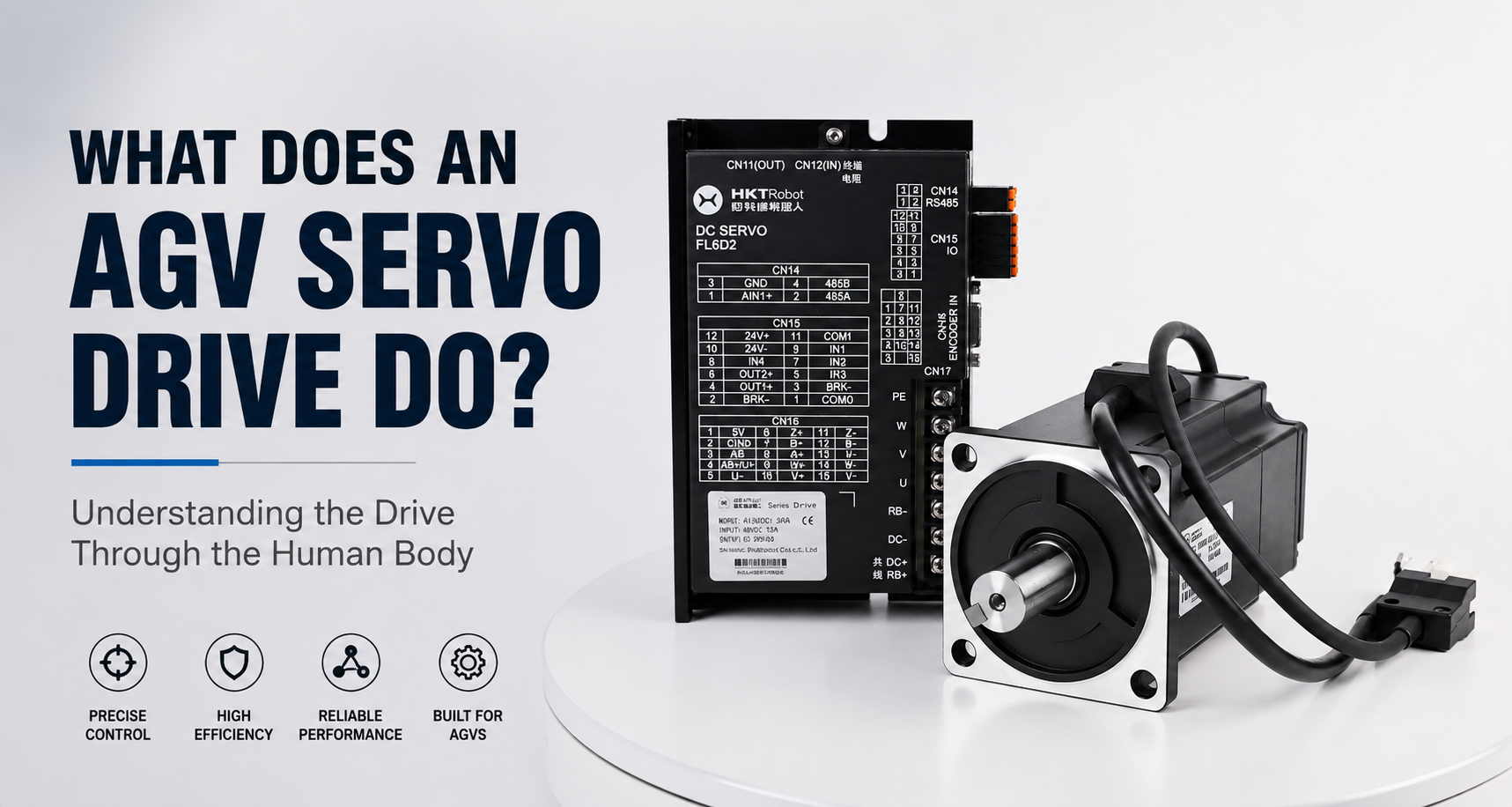
Pida a la mayoría de las personas que expliquen qué es un AGV y describirán las piezas que pueden ver: ruedas, un chasis, una batería, tal vez un escáner láser. Pida a un ingeniero nuevo en robótica móvil que explique el servocontrolador y la respuesta suele ser más vaga: algo entre el controlador y el motor, algo relacionado con la potencia. Esa vaguedad es importante, porque el servocontrolador influye más en cómo se siente realmente un vehículo en funcionamiento que casi cualquier otro componente individual. La forma más útil de entenderlo es dejar de pensar en un AGV como una máquina y empezar a pensar en él como un cuerpo.

Mapeo de un AGV sobre un cuerpo
Antes de entrar en el controlador específicamente, ayuda ver el mapa completo a la vez. Cada parte de la transmisión de un AGV tiene una contraparte biológica razonablemente cercana.
| Componente del AGV | Equivalente corporal | Función compartida |
|---|---|---|
| Sistema de gestión de flota | Intención consciente | Decide a dónde ir y por qué |
| Controlador del vehículo | Cerebro | Planifica la ruta, coordina todo el cuerpo |
| Servocontrolador | Arco reflejo espinal | Convierte la intención en fuerza regulada, corrige local y rápidamente |
| Servomotor | Músculo | Produce la fuerza real |
| Caja de cambios | Tendón y apalancamiento articular | Intercambia velocidad por fuerza |
| Encoder | Propiocepción | Informa sobre la posición y el movimiento continuamente |
| Batería y bus de CC | Metabolismo y circulación | Almacena y entrega energía |
| Circuito de seguridad | Reflejo de dolor y retirada | Detiene la acción antes de que ocurra un daño |
La parte interesante de este mapa no es el motor ni el controlador; esos se asignan al músculo y al cerebro de formas que la mayoría de la gente encuentra intuitivas. Es el controlador, que ocupa un papel en el cuerpo en el que la mayoría de las personas nunca piensa conscientemente, precisamente porque está diseñado para funcionar sin pensamiento consciente.
El controlador es el cerebro, pero el cerebro no mueve nada
El controlador del vehículo decide. Lee los datos de navegación, planifica una ruta, determina que el vehículo debe viajar hacia adelante a cierta velocidad y detenerse en cierto punto, y emite las órdenes correspondientes. Esto es una toma de decisiones genuina, y es donde reside la mayor parte de la complejidad del software en un AGV.
Pero el cerebro no tiene contacto directo con el suelo. No puede aplicar par a una rueda. Todo lo que decide tiene que traducirse en algo sobre lo que un músculo pueda actuar, y esa traducción ocurre en otro lugar completamente diferente. Cuando una persona decide ponerse de pie, el cerebro no especifica cuánta tensión debe producir cada fibra muscular individual, momento a momento, a medida que el peso corporal cambia. Emite una intención. Algo por debajo completa los detalles.
La misma división existe en un AGV. El controlador envía un comando de velocidad o posición, quizás cada pocos milisegundos. No especifica la corriente en cada bobinado del motor microsegundo a microsegundo. Si lo intentara, se vería abrumado y el vehículo se movería mal.

El servocontrolador es el arco reflejo espinal
En el cuerpo, un arco reflejo es un bucle que va desde un sensor, pasa por la médula espinal y regresa a un músculo, sin llegar hasta el cerebro. Existe porque algunas correcciones deben ocurrir más rápido de lo que permite el pensamiento consciente. Cuando pisas una superficie irregular y tu tobillo comienza a torcerse, la corrección estabilizadora ya ha comenzado antes de que seas consciente de que algo sucedió.
El servocontrolador es este bucle. Recibe una intención del controlador, luego cierra sus propios bucles de control localmente, a velocidades mucho más altas que la tasa de comando desde arriba. Un bucle de corriente generalmente funciona en decenas de kilohercios. Un bucle de velocidad funciona en los kilohercios bajos. El controlador, por comparación, puede actualizar su comando solo unos cientos o mil veces por segundo. Entre cada comando del controlador, el controlador ya ha realizado miles de correcciones independientes.
Por qué importan los bucles locales
Considere un AGV cruzando una junta de dilatación del suelo mientras lleva una carga. La rueda encuentra resistencia y el motor comienza a reducir la velocidad. Esperar a que el controlador note el error de velocidad, calcule una corrección, la transmita a través del bus de campo y haga que el controlador actúe sobre ella introduciría un retraso lo suficientemente largo como para ser visible como un tirón en el movimiento del vehículo. En cambio, el controlador ve la desviación de velocidad en su propio bucle de retroalimentación y aumenta la corriente inmediatamente. El controlador nunca necesita saber que sucedió.
Esto es lo más importante que hay que entender sobre el servocontrolador: no es una etapa de potencia pasiva que simplemente amplifica lo que el controlador pide. Es un regulador activo con sus propios sentidos y sus propios reflejos, que opera en una escala de tiempo mucho más rápida que cualquier cosa por encima de él.
Cómo es el movimiento sin un buen arco reflejo
Cuando la capa de reflejos es débil —un controlador mal especificado, bucles mal ajustados o espacio libre de corriente insuficiente—, los síntomas son reconocibles para cualquiera que haya observado un AGV mal integrado. El vehículo da tirones al inicio del movimiento en lugar de acelerar suavemente. Se arrastra de manera desigual a baja velocidad en lugar de deslizarse. Se pasa de su punto de parada y se estabiliza con un balanceo visible. Lucha desproporcionadamente en rampas o sobre transiciones de suelo.
Ninguno de estos síntomas son fallas del motor. El músculo está bien. El reflejo que regula el músculo no está haciendo su trabajo.
Convertir la intención en fuerza: lo que realmente hace el controlador
Por debajo del nivel del bucle de reflejos, el controlador realiza una función más cercana a la unión neuromuscular, el punto donde una señal nerviosa se convierte en una contracción muscular real.
Control de corriente y par
El par en un servomotor es producido por la corriente. El trabajo más fundamental del controlador es regular esa corriente con precisión, lo que significa que está regulando la fuerza. Cuando un AGV necesita más par para mover un palé más pesado, nadie añade un motor más grande en ese momento; el controlador simplemente entrega más corriente, dentro de los límites que se han configurado. Esto refleja cómo el cuerpo produce más fuerza desde el mismo músculo: no haciendo crecer tejido nuevo, sino reclutando más unidades motoras y disparándolas más rápidamente.
Conmutación
Un servomotor sin escobillas produce una rotación suave solo si sus bobinados se energizan en la secuencia correcta en relación con la posición del rotor. El controlador realiza esta secuenciación continuamente, miles de veces por segundo, basándose en la retroalimentación sobre dónde está el rotor actualmente. Si te equivocas un poco, el motor aún gira, pero con un par reducido, un mayor consumo de corriente y más calor: el equivalente mecánico de un músculo que se contrae ligeramente fuera de coordinación.
Regulación de energía
El controlador también gestiona el flujo de energía en ambas direcciones. Cuando un AGV desacelera, el motor actúa como un generador y devuelve energía hacia la batería. El controlador decide qué sucede con esa energía que regresa, si el bus puede absorberla o si debe disiparse. No hay un equivalente biológico limpio para esto, que es uno de los lugares donde la analogía comienza a tensarse.

El encoder es el sentido de posición del cuerpo
Un arco reflejo es inútil sin entrada sensorial. En el cuerpo, la propiocepción (la sensación de dónde están tus extremidades sin mirarlas) proviene de receptores en los músculos y tendones que informan continuamente sobre la longitud y la tensión. Es el sentido que la gente nota solo cuando falla.
El encoder desempeña exactamente este papel. Informa la posición y velocidad del rotor continuamente al controlador, que es lo que hace posible el control de bucle cerrado en absoluto. Quítelo y el controlador estará operando a ciegas, capaz de empujar pero incapaz de saber qué ha logrado su empuje. Degradarlo —a través de ruido eléctrico, mal enrutamiento de cables o resolución insuficiente— y el controlador recibirá datos sensoriales poco fiables, lo que produce exactamente el tipo de movimiento inestable y vacilante que esperarías de un cuerpo con un sentido de posición deteriorado.
Músculo y apalancamiento: el motor y la caja de cambios
El motor es músculo en el sentido más directo: convierte la energía en fuerza mecánica y lo hace solo cuando se le ordena. Su clasificación define cuánta fuerza está disponible, pero no qué tan bien se aplica esa fuerza.
La caja de cambios está más cerca de la geometría de los tendones y el apalancamiento articular. Un músculo unido cerca de una articulación produce un movimiento rápido con menos fuerza; unido más lejos, produce un movimiento más lento con más fuerza. El músculo en sí no ha cambiado, la ventaja mecánica sí. Una caja de cambios hace lo mismo, intercambiando la velocidad del motor por el par de la rueda en una relación fija. Es por eso que la selección de la relación de transmisión y la selección del motor no pueden decidirse de forma independiente, al igual que las proporciones de las extremidades y la capacidad muscular no son independientes en la biomecánica.
Reflejos protectores
El cuerpo tiene reflejos cuyo único propósito es prevenir daños. Toca algo caliente y la retirada ocurre antes de que la sensación se registre conscientemente, porque enrutar esa decisión a través del cerebro tomaría demasiado tiempo para prevenir lesiones.
El servocontrolador lleva la misma clase de función. La protección contra sobrecorriente interrumpe el funcionamiento cuando la corriente excede los límites seguros, lo que ocurre cuando una rueda se atasca o se le pide a un vehículo que empuje contra un obstáculo inamovible. La protección contra sobretemperatura responde a la carga térmica sostenida. El "Safe Torque Off" (par seguro desactivado) elimina la capacidad del controlador para producir par por completo cuando se rompe un circuito de seguridad, independientemente de lo que el controlador pueda estar ordenando en ese momento.
La característica crítica que comparten con los reflejos protectores biológicos es que actúan local e inmediatamente. Una función de protección que tuviera que pedir permiso al controlador llegaría frecuentemente demasiado tarde para proteger algo.

Cuando falla la capa de reflejos: reconocer problemas a nivel de controlador
Enmarcar el controlador de esta manera hace que una distinción de diagnóstico útil esté disponible. Los problemas en la transmisión de un AGV tienden a caer en capas, y la identificación de la capa estrecha la búsqueda dramáticamente.
Si el vehículo va al lugar equivocado, sigue una mala trayectoria o se detiene en la secuencia incorrecta, el problema está en la capa de decisión: navegación o lógica del controlador. Los reflejos se ejecutaron correctamente; la intención era incorrecta.
Si el vehículo va al lugar correcto pero llega allí de mala manera (dando tirones, oscilando, pasándose de largo, desviándose de una línea recta, luchando en pendientes), el problema está en la capa de reflejos. La intención era correcta y el músculo es capaz, pero la regulación entre ellos es inadecuada. Este es el dominio del controlador, y cubre el ajuste, el margen de corriente, la calidad de la retroalimentación y la selección del controlador.
Si el vehículo no puede producir suficiente fuerza en absoluto independientemente de qué tan bien esté regulado, el problema es muscular: dimensionamiento del motor o la caja de cambios. Ninguna cantidad de ajuste del controlador crea un par que el motor no pueda producir. Un desglose práctico de las fallas específicas que aparecen en la capa de reflejos está disponible en esta guía sobre problemas comunes de servocontroladores AGV.
Dónde se rompe la analogía
Las analogías son útiles hasta que se confía demasiado en ellas, y esta tiene límites claros que vale la pena nombrar.
El músculo biológico funciona en pares opuestos: un músculo tira de una articulación hacia un lado, otro tira de ella hacia atrás. Un servomotor es bidireccional por sí solo, produciendo par en cualquier dirección desde un solo actuador. La estructura antagonista que da forma a gran parte de la biomecánica simplemente no se aplica.
El cuerpo tampoco tiene equivalente al frenado regenerativo. Los músculos no pueden devolver energía al torrente sanguíneo durante la desaceleración; la disipan en forma de calor. Un controlador de AGV empuja rutinariamente energía hacia la batería, y gestionar ese flujo de retorno es una consideración de diseño real sin contraparte biológica.
Finalmente, los reflejos biológicos se adaptan y se reentrenan con el tiempo a través del uso. Los bucles de un servocontrolador no aprenden por sí solos: se configuran durante la puesta en marcha y permanecen tal como se establecieron hasta que alguien los cambia. Los reflejos son tan buenos como la persona que los ajustó, lo cual es una limitación que el cuerpo no comparte.
Preguntas frecuentes
¿Cuál es la diferencia entre un controlador de AGV y un servocontrolador de AGV?
El controlador decide qué debe hacer el vehículo —ruta, velocidad, puntos de parada— y coordina todos los ejes en el vehículo. El servocontrolador ejecuta esa decisión para un motor, regulando la corriente y cerrando sus propios bucles de control de alta velocidad localmente. Un controlador generalmente comanda varios controladores. El papel del controlador se trata con mayor profundidad en esta guía sobre controladores AGV para robots móviles.
¿Puede un AGV funcionar sin un servocontrolador?
No en ninguna configuración industrial práctica. Algunos vehículos muy simples utilizan control de motor en bucle abierto sin una verdadera servorregulación, pero renuncian a la precisión, la estabilidad a baja velocidad y el control de par que las aplicaciones de AGV generalmente requieren. Eliminar la capa de reflejos significa que cada corrección tiene que venir desde arriba, demasiado lentamente para ser útil.
¿Por qué la calidad del controlador afecta qué tan suave se siente un AGV?
La suavidad es producto de qué tan rápida y precisamente se regula el par a medida que cambian las condiciones. Debido a que esas correcciones ocurren dentro de los propios bucles del controlador en lugar de ser enviadas desde el controlador principal, la calidad y el ajuste del controlador determinan el comportamiento de conducción mucho más directamente que el rendimiento del controlador principal.
¿Cambia un controlador integrado esta relación?
Físicamente, sí: una unidad integrada coloca la electrónica del controlador sobre o dentro del motor, reduciendo el cableado y ahorrando espacio. Funcionalmente, la división del trabajo no cambia: el controlador sigue realizando la regulación local mientras el controlador principal sigue decidiendo. El arco reflejo simplemente se ha movido más cerca del músculo.
Si el motor es el músculo, ¿por qué no comprar un motor más grande cuando el rendimiento es deficiente?
Porque la mayoría de las quejas de rendimiento en las transmisiones de AGV son problemas de regulación en lugar de problemas de fuerza. Un motor más grande añade par disponible, pero si el vehículo está dando tirones, oscilando o desviándose de una trayectoria recta, el par disponible nunca fue la restricción. Diagnosticar la capa antes de cambiar el hardware evita pagar por una capacidad que no aborda el síntoma.
Conclusión
El servocontrolador ocupa la posición menos visible en la transmisión de un AGV y ejerce una influencia desproporcionada en cómo se comporta el vehículo. Verlo como el arco reflejo espinal —recibiendo intención desde arriba, regulando la fuerza por debajo, corrigiendo localmente a velocidades que nada más en el sistema puede igualar, y protegiendo el cuerpo sin pedir permiso— hace que tanto su función como sus modos de falla sean considerablemente más fáciles de razonar. También aclara un punto práctico que importa en el momento del diseño: especificar un motor capaz mientras se subespecifica el controlador que lo regula produce un vehículo con músculos fuertes y reflejos pobres, lo que en funcionamiento no es un vehículo fuerte en absoluto.
Compartir:
Guía de selección de ruedas motrices AGV para robots autónomos empujadores de alimento
Ruedas motrices de dirección de carga ligera para diseño de AGV/AMR compactos