

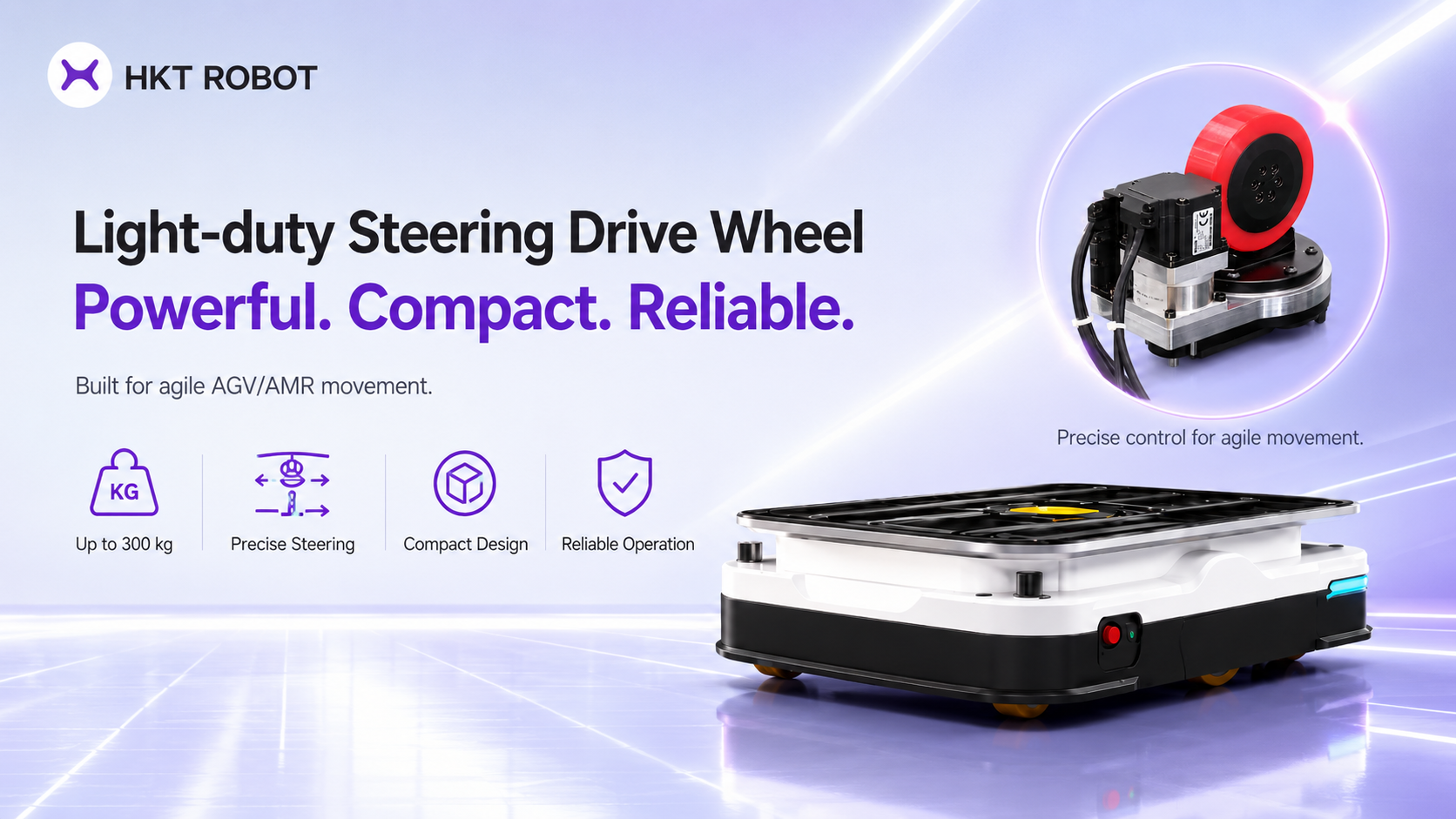
Admitámoslo: no todos los AGV necesitan un sistema de tracción de alta resistencia.
Para los robots móviles compactos, una rueda motriz de dirección más grande a veces puede crear más problemas de los que resuelve. Ocupa más espacio en el chasis, añade peso y puede requerir un motor más grande y más potencia de la que la aplicación realmente necesita.
Para un AGV o AMR de carga ligera, la mejor opción suele ser una rueda motriz de dirección compacta para AGV que se adapte a la carga útil real, el espacio de instalación disponible, la velocidad y los requisitos de movimiento.
Esto es especialmente importante a medida que los robots móviles se vuelven más pequeños y se utilizan en aplicaciones de interior más flexibles.

Ventajas y limitaciones de una rueda motriz de dirección pequeña
Una rueda motriz de dirección pequeña puede ser una elección inteligente para AGV y AMR de carga ligera. Sus principales ventajas incluyen:
-
Ahorra espacio en el chasis: Su tamaño compacto deja más espacio para baterías, sensores, controladores y otros componentes.
-
Reduce el peso del vehículo: Un sistema de tracción más pequeño ayuda a mantener el AGV ligero y más fácil de mover.
-
Consume menos energía: El motor no necesita manejar cargas que superen los requisitos reales del vehículo, lo que puede mejorar la eficiencia energética.
-
Proporciona un movimiento flexible: Admite una dirección controlada y un giro suave en espacios interiores estrechos.
-
Simplifica el diseño del vehículo: Su estructura integrada puede hacer que el diseño sea más compacto y reducir las piezas mecánicas innecesarias.
-
Ofrece un mejor control de costes: Adaptar la rueda a la carga útil real evita pagar por una capacidad que el AGV no necesita.
-
Se adapta a aplicaciones compactas: Funciona bien para AMR pequeños, robots de entrega en interiores, robots de inspección y vehículos ligeros de manipulación de materiales.
La principal limitación es su menor capacidad de carga e impacto en comparación con una rueda motriz de dirección de alta resistencia. También puede requerir un suelo relativamente liso y un control preciso para mantener una tracción y dirección estables.

¿Dónde se utilizan las ruedas motrices de dirección de carga ligera?
Los sistemas de dirección de carga ligera pueden utilizarse en muchos tipos de robots móviles de interior.
AMR compactos para almacenes
No todos los robots de almacén mueven palés.
Muchos AMR transportan cajas, contenedores, herramientas, piezas y otras cargas pequeñas entre estaciones de trabajo o zonas de almacenamiento.
Estos robots suelen necesitar un chasis compacto para poder moverse por pasillos estrechos y trabajar cerca de personas o equipos. Una unidad motriz de dirección más pequeña puede facilitar mucho el diseño del chasis.
Electrónica y fabricación 3C
Las fábricas de electrónica a menudo necesitan robots móviles para desplazar componentes, bandejas, accesorios o productos semiacabados entre los procesos de producción.
Es posible que la carga útil no sea muy elevada, pero el movimiento suave, la precisión de posicionamiento y las dimensiones compactas del vehículo son importantes.
En estas aplicaciones, utilizar una dirección de alta resistencia sobredimensionada puede añadir costes y tamaño sin aportar muchos beneficios reales.
AGV de perfil bajo
Los AGV de perfil bajo o subyacentes están diseñados para moverse por debajo de estanterías, carros o transportadores de material.
Aquí, la altura de instalación se convierte en uno de los límites de diseño más importantes.
La rueda motriz debe encajar en un chasis muy restringido y, aun así, proporcionar suficiente par, capacidad de carga y rendimiento de dirección.
Por este motivo, las unidades motrices de dirección compactas y de bajo perfil son especialmente útiles para este tipo de AGV.
Robots móviles médicos y de laboratorio
Los hospitales y laboratorios son otra área en crecimiento para los robots móviles pequeños.
Estos robots pueden transportar medicamentos, muestras, instrumentos o suministros entre diferentes áreas.
En comparación con los AGV industriales pesados, sus cargas suelen ser menores. El movimiento suave, el bajo nivel de ruido, las dimensiones compactas y un control fiable suelen ser más importantes que una capacidad de carga extremadamente alta.
Plataformas robóticas móviles personalizadas
Muchas empresas de robótica e integradores de sistemas también están desarrollando plataformas móviles personalizadas para inspección, servicios, investigación, entretenimiento y automatización de fábricas.
Estos proyectos pueden tener diseños muy diferentes.
Algunos necesitan una dirección motriz con ruedas locas pasivas. Otros utilizan dos direcciones motrices para una mayor control y flexibilidad.
Para estos clientes, tener varias opciones de dirección motriz compacta facilita la adaptación del sistema de tracción al robot real en lugar de rediseñar el chasis alrededor de una rueda sobredimensionada.
¿Qué debe comprobar antes de seleccionar una dirección motriz compacta?
Antes de elegir una rueda motriz de dirección para AGV de carga ligera, deben confirmarse varios parámetros:
-
Peso total del vehículo y carga útil máxima
-
Número y posición de las ruedas motrices de dirección
-
Diámetro de rueda y altura de instalación requeridos
-
Velocidad y aceleración máximas
-
Condición del suelo e inclinación
-
Voltaje del sistema
-
Potencia del motor y relación de transmisión
-
Tipo de codificador y requisitos de posicionamiento
-
Requisitos de frenado
-
Protocolo de comunicación como CANopen o EtherCAT
Estos factores se influyen mutuamente.
Una rueda más pequeña puede ayudar a reducir la altura del chasis, pero puede requerir una relación de velocidad diferente. Una mayor velocidad puede requerir más potencia del motor. Una carga desplazada pesada también puede cambiar el peso que realmente soporta cada rueda motriz.
Por lo tanto, la selección de la tracción debe basarse en el vehículo completo, no solo en un parámetro.
Soluciones de dirección motriz de HKT ROBOT para AGV y AMR de carga ligera
Respaldado por años de experiencia en la industria, HKT ROBOT proporciona componentes de tracción para diferentes configuraciones de chasis de AGV y AMR, incluyendo ruedas motrices de dirección, unidades de ruedas motrices diferenciales, servomotores, servoaccionamientos, cajas de cambios y soluciones relacionadas de control de movimiento.
Nuestra gama de direcciones motrices incluye opciones compactas para robots móviles más ligeros, así como soluciones más grandes para AGV de carga media y pesada. Por ejemplo, disponemos de ruedas motrices de dirección horizontales de 48V con una capacidad nominal de 200 kg por rueda, junto con modelos de mayor carga para aplicaciones industriales.
Más importante aún, no recomendamos una rueda motriz basándonos únicamente en la capacidad de carga.
Al apoyar un proyecto de AGV o AMR, analizamos la aplicación completa, incluyendo el peso del vehículo, la carga útil, la velocidad, el diámetro de la rueda, el espacio de instalación, la relación de transmisión, el codificador, el freno y los requisitos de control.
En HKT ROBOT, también ofrecemos servoaccionamientos de bajo voltaje con opciones de comunicación que incluyen CANopen, Modbus y RS485, lo que permite adaptar el motor y el sistema de control a diferentes arquitecturas de AGV.
Ya sea que esté desarrollando un AMR de almacén compacto, un AGV de perfil bajo, un robot de manipulación de materiales para electrónica o una plataforma móvil personalizada, seleccionar el sistema de tracción adecuado desde el principio puede facilitar el diseño de todo el chasis.
Si no está seguro de qué dirección motriz se adapta a su robot, envíenos el peso del vehículo, la carga útil, la velocidad, el tamaño de la rueda, el espacio de instalación y los requisitos de control.
Nuestro equipo puede ayudarle a seleccionar una solución de dirección motriz adecuada para su proyecto de AGV o AMR.
Compartir:
¿Qué hace un servovariador de AGV? Entender el accionamiento a través del cuerpo humano
Cómo elegir un controlador de AGV para diferentes sistemas de tracción de AGV y AMR