

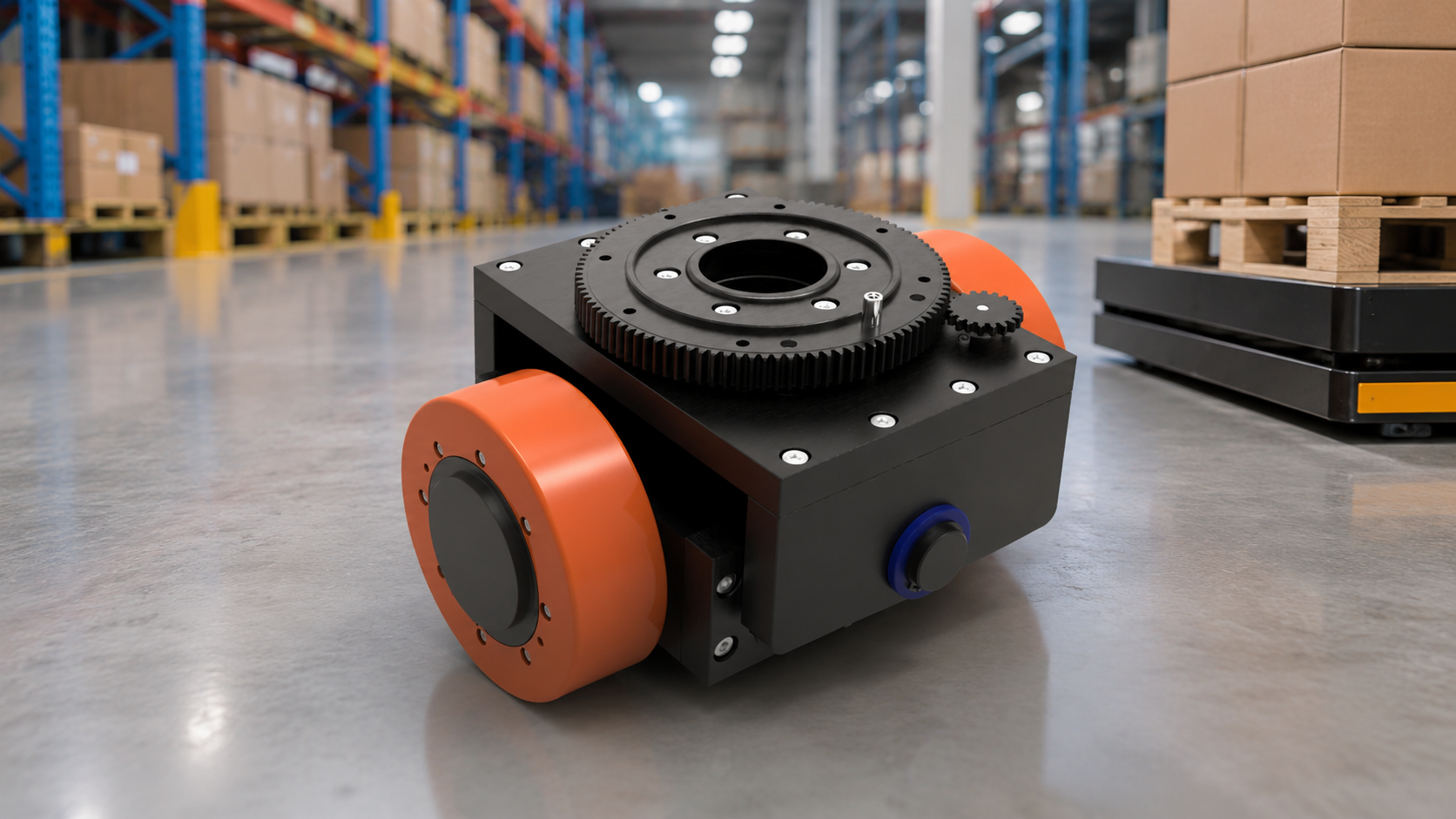
En un sistema AGV/AMR, el módulo de la rueda de dirección no es solo una rueda que impulsa y gira. Es una de las unidades de movimiento clave en el chasis del robot móvil, que afecta directamente la capacidad de carga, la flexibilidad de dirección, la estabilidad de la trayectoria, la respuesta de control y el costo de mantenimiento a largo plazo.
En muchos proyectos, las primeras preguntas suelen ser sencillas:
¿Cuánta carga puede transportar?
¿Qué tan rápido puede correr?
¿Es suficiente la precisión de la dirección?
Estas preguntas son importantes, pero rara vez son suficientes para una selección confiable. En aplicaciones reales, una rueda de dirección que parece adecuada en una hoja de especificaciones aún puede enfrentar problemas durante las pruebas del vehículo o la operación en el sitio.
La razón es que la selección de la rueda de dirección del AGV no es una comparación de un solo parámetro. La carga, la velocidad, el torque, la precisión de la dirección, el espacio de instalación, la condición del piso, el protocolo de comunicación y la estrategia de mantenimiento se influyen mutuamente. Una solución adecuada no siempre es la que tiene la especificación más alta, sino la que se adapta a la estructura real del vehículo y al entorno de trabajo.

La coincidencia de carga no se trata solo del peso estático
Uno de los primeros desafíos en la selección de la rueda de dirección del AGV es la evaluación de la carga.
En la operación real, la carga sobre cada rueda no es fija. Cambia con la posición de la carga, el centro de gravedad del vehículo, la aceleración, el frenado, el giro, las pendientes, la vibración y las condiciones del piso. Si la selección se basa únicamente en el peso total del vehículo dividido por el número de ruedas, la carga dinámica real puede subestimarse.
Por ejemplo, cuando un AGV de carga pesada frena repentinamente o gira con carga, la rueda de dirección no solo soporta el peso vertical. También puede enfrentar impacto por inercia, fuerza lateral y concentración de carga a corto plazo. Si la rueda seleccionada tiene un margen de carga limitado, esto puede provocar un desgaste más rápido de los neumáticos, una tracción reducida, una dirección inestable o una vida útil más corta de los rodamientos y reductores.
Desde una perspectiva de fabricación y aplicación, la carga estática solo debe ser el punto de partida. El peso del vehículo, la carga útil máxima, la distribución de la carga, la velocidad, la aceleración, el modo de frenado y el factor de seguridad deben revisarse en conjunto. Para plataformas de servicio pesado, AGV de elevación o proyectos en el extranjero de larga duración, dejar suficiente margen de carga dinámica suele ser más importante que elegir el modelo más pequeño posible.
La velocidad, el par y la relación de transmisión deben estar equilibrados
Muchos proyectos de AGV desean una mayor velocidad de desplazamiento. Pero una mayor velocidad generalmente trae otra pregunta: ¿aún hay suficiente margen de par?
La velocidad de desplazamiento de un módulo de rueda de dirección está relacionada con el diámetro de la rueda, la velocidad del motor, la relación de transmisión y la condición de carga. Una relación de transmisión más alta generalmente proporciona un par de salida más fuerte, lo que es útil para cargas pesadas, pendientes y operación estable a baja velocidad. Pero puede limitar la velocidad máxima. Una relación de transmisión más baja puede aumentar la velocidad, pero el margen de par en condiciones de arranque, frenado, pendiente o carga pesada debe verificarse nuevamente.
Este es un conflicto común en la selección de la rueda de dirección del AGV. Un cliente puede querer un vehículo más rápido, pero el sitio real también puede requerir cargas pesadas, operación frecuente de arranque y parada, subida de pendientes o acoplamiento preciso en pasillos estrechos. En este caso, la velocidad no debe evaluarse sola. El ritmo de funcionamiento real del vehículo importa más.
Para los AGV de transferencia de almacén, el movimiento frecuente a corta distancia y el control estable a baja velocidad pueden ser más importantes que la velocidad máxima. Para la logística de fábrica de larga distancia, la velocidad de desplazamiento y la capacidad de operación continua pueden volverse más críticas.
En los proyectos de HKT-ROBOT, la selección de la rueda de dirección generalmente se discute junto con la carga del vehículo, la velocidad objetivo, la condición del piso y el método de control. Un módulo de rueda de dirección no funciona solo. Necesita coincidir con el servomotor de 48 V, el servocontrolador, el controlador y la estrategia de movimiento general del vehículo.
La precisión de la dirección se trata de estabilidad, no solo de giro
Para los vehículos AGV/AMR, el rendimiento de la dirección afecta directamente el control de la trayectoria. Esto es especialmente importante en pasillos estrechos, manipulación de estantes, estaciones de acoplamiento, transferencia de líneas de producción y aplicaciones de posicionamiento de alta precisión.
Sin embargo, una dirección más rápida no siempre es mejor.
Si la respuesta de la dirección es demasiado lenta, el vehículo puede sentirse ineficiente durante los cambios de trayectoria y el ajuste de la postura. Si la respuesta de la dirección es demasiado rápida, pero el algoritmo de control, la retroalimentación del codificador y la estructura mecánica no están bien ajustados, el vehículo puede experimentar vibraciones, sobreimpulso o corrección de trayectoria inestable.
En algunas aplicaciones de alta precisión, como fábricas de semiconductores, fabricación de electrónica de precisión o sistemas de inspección automatizados, el AGV debe moverse suavemente incluso a baja velocidad. En este caso, la clave no es solo la potencia del motor. La vibración a baja velocidad, la resolución del codificador, el ciclo de control, el retraso de la comunicación y el juego mecánico se vuelven importantes.
Una solución más confiable debe considerar tanto el lado mecánico como el lado de control. La estructura de la dirección necesita suficiente rigidez y poco juego. El sistema de accionamiento necesita una retroalimentación estable. El protocolo de comunicación también debe admitir los requisitos de control en tiempo real. CANopen, EtherCAT y otros protocolos industriales pueden afectar la eficiencia de integración y la respuesta de la dirección en la coordinación de múltiples ruedas.
Los entornos de trabajo complejos pueden aumentar el riesgo de selección
Muchos problemas con las ruedas de dirección no aparecen en un laboratorio. Aparecen en el piso real.
La misma rueda de dirección puede funcionar sin problemas en un piso de epoxi plano, pero comportarse de manera muy diferente en pisos de concreto, pisos de esmeril, áreas de almacenamiento en frío, talleres de soldadura o sitios de producción polvorientos. La fricción del piso, la pendiente, las juntas, el aceite, el polvo, las virutas de metal, la humedad y los cambios de temperatura pueden afectar la tracción, el ruido, el desgaste y la vida útil de la dirección.
En el almacenamiento en frío, los materiales de neumáticos ordinarios pueden volverse más duros y perder agarre. En los talleres de soldadura, las virutas de metal pueden entrar en el mecanismo de dirección y afectar los rodamientos o las estructuras de sellado. En entornos de sala limpia o laboratorio, pueden aparecer requisitos adicionales en cuanto a ruido, partículas, electricidad estática o interferencia electromagnética.
Por eso el entorno de trabajo debe confirmarse con anticipación. El material de la banda de rodadura, la dureza, el proceso de recubrimiento de caucho, el grado de protección, la estructura de sellado, el método de lubricación y la planificación de las piezas de repuesto deben considerarse antes de que el producto entre en operación real.
Para los proveedores centrados en sistemas de accionamiento AGV/AMR, ruedas motrices, módulos de ruedas directrices, ruedas recubiertas de caucho y piezas de mantenimiento, no deben tratarse como elementos separados. Si la condición del suelo y la frecuencia de operación están claras en la etapa inicial, resulta más fácil seleccionar el material de la rueda, el margen de carga y la estrategia de reemplazo.
El espacio de instalación a menudo decide si una solución se puede utilizar
Otro problema común es que la especificación de la rueda de dirección parece adecuada, pero el vehículo no puede instalarla realmente.
El espacio del chasis del AGV suele ser limitado. Las baterías, los gabinetes eléctricos, los sensores, el cableado, los mecanismos de elevación y las estructuras de bastidor reforzadas ocupan espacio. Un módulo de rueda de dirección no se trata solo del tamaño del cuerpo. La altura de instalación, los orificios de la brida, el espacio libre de rotación, la dirección de salida del cable, la distancia al suelo y el acceso de mantenimiento deben verificarse.
Para los AGV de perfil bajo, la altura de instalación es especialmente sensible. Si la rueda de dirección es demasiado alta, puede afectar el centro de gravedad del vehículo y el diseño del bastidor. Si la distancia al suelo es demasiado baja, el vehículo puede interferir con pendientes, juntas del suelo u pequeños obstáculos. Para los AGV de elevación y rotación, también es necesario revisar la relación espacial entre la rueda de dirección, la unidad de elevación y el mecanismo de rotación.
Por esta razón, la selección de la rueda de dirección no debe basarse únicamente en una imagen del producto o en un dibujo básico. Un enfoque mejor es colocar el modelo de la rueda de dirección en la estructura 3D del vehículo y verificar los orificios de montaje, el radio de giro, el enrutamiento de cables y la accesibilidad para el mantenimiento antes de la selección final.
El costo debe evaluarse durante todo el ciclo de vida
El costo de una rueda de dirección AGV no es solo el precio de compra. El costo real debe incluir el mantenimiento del ciclo de vida.
Una rueda de dirección de bajo costo puede reducir el presupuesto inicial, pero si la vida útil del rodamiento es corta, el neumático se desgasta rápidamente, el accionamiento es difícil de ajustar o las piezas de repuesto son inestables, el costo de mantenimiento pronto puede exceder el ahorro inicial. Para líneas de producción continuas o sistemas de almacén, una parada no planificada puede costar más que la diferencia de precio entre dos opciones de rueda de dirección.
Por lo tanto, la selección también debe considerar factores a largo plazo. ¿Se puede reemplazar fácilmente el neumático? ¿Se pueden hacer copias de seguridad de los parámetros del accionamiento? ¿Son estables el motor y el codificador? ¿Es fácil mantener el cableado? ¿Puede el proveedor proporcionar piezas de repuesto y soporte técnico de forma continua?
Para proyectos AGV/AMR en el extranjero, esto se vuelve aún más importante. Una vez que el vehículo se entrega en el extranjero, el ciclo de reemplazo de un componente pequeño, la disponibilidad de piezas de repuesto y la velocidad de respuesta posventa pueden influir en la confianza del cliente final. Una rueda de dirección no solo debe evaluarse por el rendimiento del primer día, sino también por su capacidad de servicio a largo plazo.
La compatibilidad de hardware y software a menudo se subestima
Un módulo de rueda de dirección no es un componente que simplemente se puede encender y esperar que funcione bien. Debe trabajar en conjunto con el controlador, el servocontrolador, el algoritmo de navegación, la retroalimentación del codificador, el sistema de seguridad y las herramientas de puesta en marcha de nivel superior.
Si los parámetros mecánicos son adecuados pero la interfaz de control no está bien adaptada, pueden aparecer problemas durante la puesta en marcha. El vehículo puede corregir excesivamente su trayectoria, responder lentamente durante la dirección, vibrar durante el movimiento o activar paradas de emergencia con demasiada frecuencia. A veces, el problema parece un problema de algoritmo, pero la causa principal puede ser la respuesta de la dirección, el retraso de la comunicación, la retroalimentación del codificador o la falta de coincidencia de los parámetros de la unidad.
Por esta razón, el protocolo de comunicación, el modo de control, el tipo de codificador, la compatibilidad de la unidad, la apertura de parámetros, la coordinación de múltiples ruedas y las herramientas de depuración deben confirmarse durante la etapa de selección.
Una ventaja de HKT Robot es que el soporte de sus productos no se limita a un único componente de la rueda de dirección. En torno a los sistemas de chasis de robots móviles AGV/AMR, HKT Robot puede dar soporte a ruedas motrices, módulos de ruedas de dirección, servomotores de 48 V, servocontroladores, controladores y módulos de elevación y rotación. Para fabricantes de AGV e integradores de sistemas, este tipo de correspondencia a nivel de sistema puede ayudar a reducir la incertidumbre tanto en la selección inicial como en la puesta en marcha posterior.
Cómo encontrar la mejor solución en requisitos complejos
No hay una respuesta universal para la selección de la rueda de dirección AGV. Un método más confiable es comenzar desde los requisitos del vehículo, no desde un modelo específico.
Antes de seleccionar un módulo de rueda de dirección, es importante aclarar el tipo de vehículo, el peso total, la carga útil máxima, la velocidad objetivo, la aceleración, el requisito de pendiente, el radio de giro, el espacio de instalación, la condición del piso, el protocolo de comunicación y la estrategia de mantenimiento. Solo cuando estos detalles estén claros, el proveedor podrá decidir si el proyecto debe priorizar la capacidad de carga, el rendimiento de la velocidad, la estructura compacta, la precisión de la dirección o la comodidad de mantenimiento.
Una buena solución de rueda de dirección no suele ser la especificación más agresiva. Es la solución que se ajusta a la condición de trabajo real. Debe admitir pruebas de prototipos, producción en serie futura, operación a largo plazo y servicio postventa.
Conclusión
El desafío de la selección de la rueda de dirección AGV no se trata de encontrar la carga más alta, la velocidad más rápida o el tamaño más pequeño. Se trata de comprender la relación entre el sistema del vehículo y el entorno de trabajo.
Una solución de rueda de dirección confiable necesita equilibrar la estructura mecánica, la capacidad de accionamiento, la respuesta de control, el espacio de instalación, la adaptabilidad ambiental y el costo del ciclo de vida. Para los proyectos AGV/AMR, la rueda de dirección no es una parte aislada. Es una parte clave del sistema de movimiento completo.
Si un proyecto aún se encuentra en la etapa de diseño o prototipo, es mejor definir la carga, la velocidad, el espacio de instalación, la condición del piso, el protocolo de control y el escenario de aplicación lo antes posible. Esto facilita la búsqueda de una solución de rueda de dirección adecuada y reduce los riesgos posteriores en el rediseño, la puesta en marcha y el soporte posventa.
Para proyectos que requieren evaluar en conjunto ruedas motrices, módulos de ruedas de dirección, servomotores, servocontroladores, controladores o módulos de elevación y rotación, HKT Robot puede brindar soporte en la selección basándose en las condiciones de trabajo reales y los requisitos de la aplicación.
Compartir:
Por qué la caja de engranajes planetarios es la columna vertebral del tren motriz de todo AGV
Estructura y principio de funcionamiento de las ruedas de dirección de los AGV robóticos de HKT: desde la propulsión y la dirección hasta la selección personalizada