

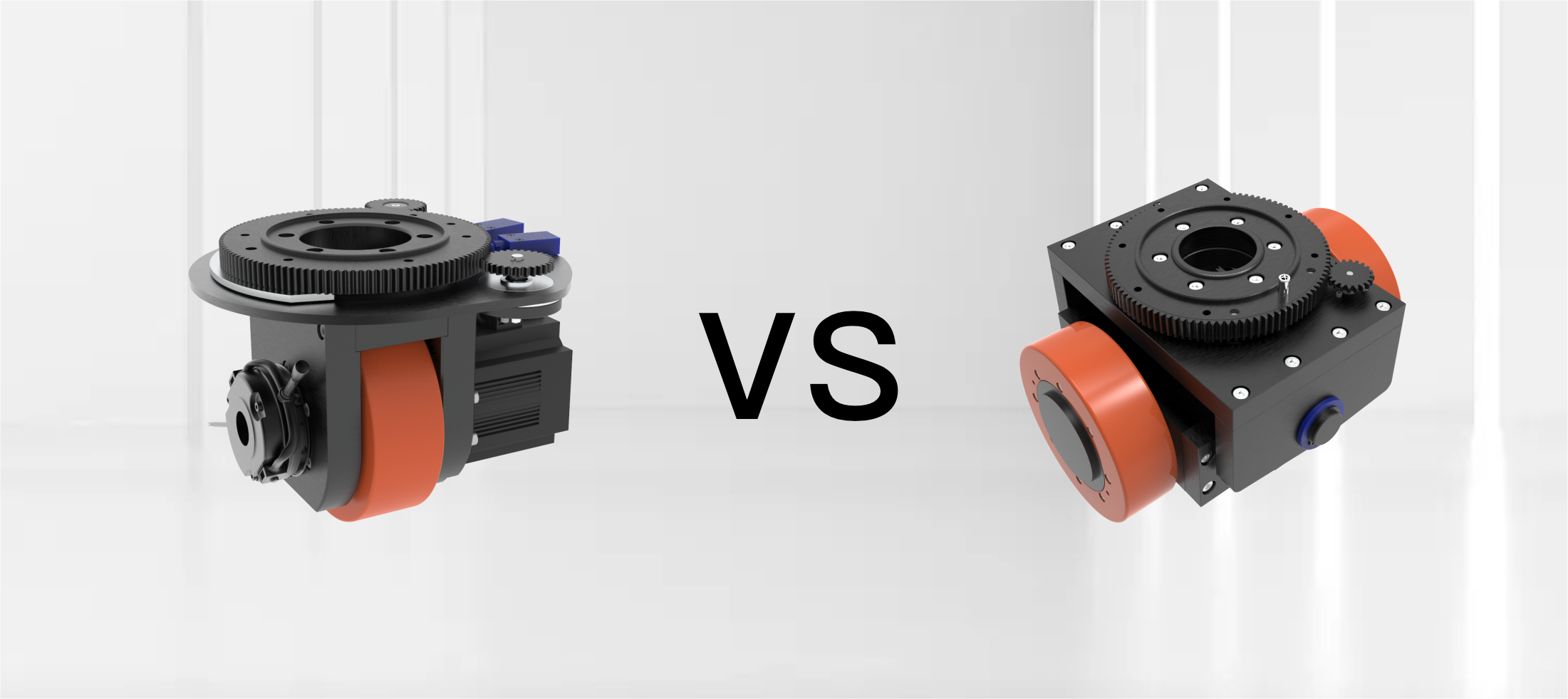
En el diseño de chasis AGV y AMR, los sistemas de tracción en el volante y los sistemas de tracción diferencial son las dos soluciones de movimiento más utilizadas.
Cada estructura difiere significativamente en maniobrabilidad, precisión de control, complejidad del sistema e idoneidad para la aplicación.
La elección del método de conducción adecuado es un factor clave en el rendimiento general del AGV.
1. Principios básicos de funcionamiento
Volante AGV
Un volante integra las funciones de conducción y dirección. Los servomotores controlan tanto la velocidad del volante como el ángulo de dirección, lo que permite un control flexible del movimiento. Las configuraciones pueden incluir volantes individuales, dobles o múltiples.
Transmisión diferencial
Los sistemas de tracción diferencial utilizan dos ruedas con tracción independiente. La dirección se logra variando la velocidad de cada rueda. Esta estructura es mecánicamente sencilla y se utiliza ampliamente en plataformas AGV básicas.
2. Comparación de la capacidad de movimiento
| Aspecto | Volante AGV | Transmisión diferencial |
|---|---|---|
| Método de dirección | Ángulo de dirección servocontrolado | Diferencia de velocidad |
| Rotación del pivote | Apoyado | Apoyado |
| Movimiento lateral | Compatible (multi-rueda) | No compatible |
| Maniobrabilidad | Alto | Medio |
| Adaptabilidad de la trayectoria | Fuerte | Adecuado para caminos fijos |
3. Control de precisión y estabilidad
-
Sistemas de volante
-
Respuesta precisa del ángulo de dirección
-
Mejor posicionamiento y precisión de acoplamiento
-
Adecuado para aplicaciones que requieren movimiento repetible.
-
-
Sistemas de transmisión diferencial
-
Lógica de control simple
-
Más sensible a las condiciones de carga y suelo.
-
El error de posición puede acumularse a lo largo de largas distancias
-
4. Complejidad mecánica y del sistema
| Artículo | Volante AGV | Transmisión diferencial |
| Estructura mecánica | Más complejo | Simple |
| Sistema de control | Coordinación multieje | Control de movimiento básico |
| Nivel de costo | Medio a alto | Más bajo |
| Integración de sistemas | Alta flexibilidad | Fácil integración |
5. Escenarios típicos de aplicación
Los sistemas de volante son preferidos para:
-
AGV de almacén que requieren giros frecuentes y acoplamiento preciso
-
Líneas de fabricación con alta precisión de posicionamiento
-
Entornos con limitaciones de espacio
-
AGV y AMR de carga media a pesada
Los sistemas de accionamiento diferencial son adecuados para:
-
AGVs con rutas simples y fijas
-
Aplicaciones de carga ligera o baja velocidad
-
Proyectos estandarizados y sensibles a los costos
6. Directrices de selección
Los factores clave a considerar incluyen:
-
Complejidad de ruta y requisitos de movimiento
-
Precisión de posicionamiento y acoplamiento
-
Carga útil del vehículo y velocidad de operación
-
Capacidad del sistema de control
-
Requisitos de costo y escalabilidad
Los sistemas de tracción al volante se adoptan cada vez más en los AGV industriales y de almacén modernos.
Conclusión
Tanto el volante AGV como los sistemas de accionamiento diferencial tienen sus propias ventajas.
La transmisión diferencial se centra en la simplicidad y la rentabilidad, mientras que los sistemas de volante ofrecen mayor flexibilidad, precisión y escalabilidad.
Seleccionar la solución adecuada garantiza un rendimiento AGV óptimo para la aplicación prevista.
Compartir:
Descripción técnica del volante AGV para sistemas AGV y AMR
Cómo elegir el transportador de paletas adecuado para sistemas de almacén