

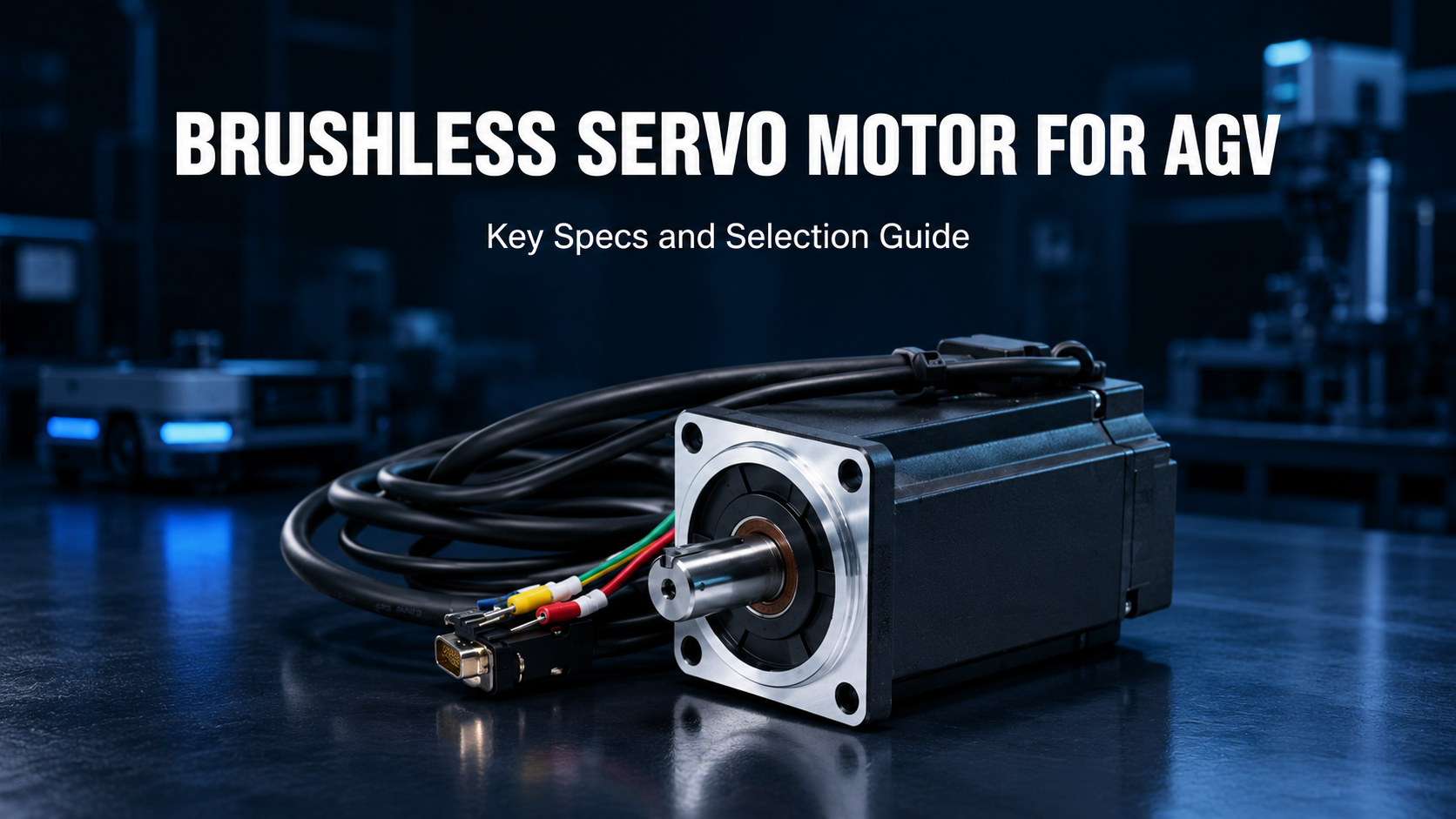
Elegir el motor adecuado es una de las decisiones más críticas en el diseño de sistemas AGV. Entre las opciones disponibles, el servomotor sin escobillas se ha convertido en la opción preferida para la mayoría de las plataformas AGV y AMR modernas, ofreciendo una eficiencia superior, una vida útil más larga y un control de movimiento preciso en comparación con las alternativas con escobillas.
Esta guía cubre todo lo que los ingenieros y los equipos de adquisiciones necesitan saber: cómo funcionan los servomotores sin escobillas, qué especificaciones son las más importantes, cómo se comparan con los motores con escobillas y cómo combinarlos con su aplicación AGV específica.

¿Qué es un servomotor sin escobillas?
Un servomotor sin escobillas (también conocido como servomotor BLDC) es un tipo de motor síncrono de imanes permanentes que elimina las escobillas físicas y el conmutador que se encuentran en los motores de CC tradicionales. En su lugar, la conmutación electrónica es manejada por un controlador de servomotor, que utiliza señales de retroalimentación de un codificador o sensor de efecto Hall para determinar la posición del rotor y ajustar el flujo de corriente en consecuencia.
En un diseño sin escobillas, los imanes permanentes están montados en el rotor, mientras que los devanados de cobre se encuentran en el estator. Esta disposición significa que no hay contacto mecánico entre los componentes giratorios y estacionarios, eliminando por completo el desgaste de las escobillas.
En las aplicaciones AGV, los servomotores sin escobillas suelen combinarse con una caja de cambios planetaria para aumentar el par de salida y reducir la velocidad a un rango adecuado para la tracción de las ruedas. También se integran comúnmente en unidades motrices compactas para una instalación que ahorra espacio en el chasis del robot.
Por qué los sistemas AGV prefieren los servomotores sin escobillas
El cambio de motores con escobillas a motores sin escobillas en plataformas de robots móviles no es arbitrario. Varias características de rendimiento hacen que los servomotores BLDC sean particularmente adecuados para las demandas del funcionamiento de AGV industriales.
Vida útil más larga
La ausencia de escobillas elimina el componente principal de desgaste en los sistemas de motor de CC. Los servomotores industriales sin escobillas logran rutinariamente vidas útiles que superan las 20.000 horas en condiciones de funcionamiento normales, una ventaja significativa en los sistemas AGV que pueden funcionar dos o tres turnos al día.
Mayor eficiencia
Los motores sin escobillas suelen alcanzar una eficiencia eléctrica a mecánica del 85-95%, en comparación con el 75-85% de los motores con escobillas equivalentes. En los sistemas AGV alimentados por batería, esta ganancia de eficiencia se traduce directamente en un mayor tiempo de funcionamiento por ciclo de carga, un impacto medible en el rendimiento del sistema.
Control preciso de velocidad y par
El control de servo de circuito cerrado permite que el motor mantenga una velocidad y un par precisos bajo diferentes condiciones de carga. Esto es esencial para las aplicaciones AGV donde el peso de la carga varía entre las operaciones de recogida y descarga, y donde la aceleración y deceleración suaves afectan directamente la seguridad del producto y la precisión de posicionamiento.
Bajos requisitos de mantenimiento
Sin programas de reemplazo de escobillas, los servomotores sin escobillas reducen significativamente los requisitos de mantenimiento planificado. En flotas AGV de alta densidad, esta reducción del tiempo de inactividad por mantenimiento contribuye directamente a la eficacia general del equipo (OEE).
Densidad de potencia compacta
Los servomotores sin escobillas ofrecen un alto par de salida en relación con su tamaño físico. Esta densidad de potencia compacta es fundamental para el diseño de plataformas AGV, donde cada kilogramo de peso del motor reduce la capacidad de carga útil y cada centímetro de longitud del motor restringe la geometría del chasis.

Especificaciones clave a evaluar
Al seleccionar un servomotor sin escobillas para una aplicación AGV, los siguientes parámetros definen el rendimiento, la compatibilidad y la fiabilidad a largo plazo.
Par nominal y par pico
El par nominal representa la salida continua que el motor puede mantener sin exceder los límites térmicos. El par pico, típicamente de 2 a 3 veces el valor nominal, refleja la salida máxima a corto plazo disponible durante la aceleración. Para aplicaciones de accionamiento AGV, el motor debe entregar suficiente par nominal a la velocidad de funcionamiento después de tener en cuenta la relación de reducción de la caja de cambios, el diámetro de la rueda y la carga útil en el peor de los casos.
Velocidad nominal y velocidad sin carga
La velocidad del motor debe coincidir con la velocidad deseada de la rueda del AGV a través de la relación de reducción de la caja de cambios. Un motor con una velocidad nominal de 3.000 rpm combinado con una caja de cambios planetaria de 30:1 produce 100 rpm en el eje de salida. Con una rueda motriz de 200 mm, esto se traduce en aproximadamente 1,05 m/s, una velocidad de desplazamiento típica de un AGV de almacén. Verifique que la curva de eficiencia del motor alcance su punto máximo en o cerca de la velocidad de funcionamiento prevista.
Tipo y resolución del codificador
El codificador proporciona retroalimentación de posición y velocidad al servomotor. Las opciones incluyen codificadores incrementales (menor costo, estándar para control de velocidad), codificadores absolutos (conserva los datos de posición en caso de pérdida de energía, adecuados para un posicionamiento preciso) y codificadores absolutos multivuelta (requeridos para sistemas que necesitan seguimiento de la posición del eje en múltiples rotaciones). La resolución, medida en pulsos por revolución (PPR), afecta la precisión del posicionamiento; la mayoría de las aplicaciones de accionamiento AGV utilizan codificadores en el rango de 2.500 a 10.000 PPR.
Tensión nominal
Los sistemas de batería AGV suelen funcionar a 24V, 48V o 72V CC. La tensión nominal del motor debe coincidir con la tensión del bus de la fuente de alimentación a bordo. Los sistemas de 48V son ahora los más comunes en plataformas AGV de almacén de carga útil media, ofreciendo un equilibrio práctico entre la densidad de energía de la batería, la eficiencia del motor y la disponibilidad de componentes de accionamiento. Las plataformas de carga pesada utilizan cada vez más 72V o más para mejorar la entrega de potencia al par nominal.
Clasificación IP y entorno operativo
El grado de protección IP determina la resistencia del motor al polvo y la humedad. Los motores AGV de almacén estándar suelen tener una clasificación IP54 o IP65. Las aplicaciones en procesamiento de alimentos, logística exterior o entornos de almacenamiento en frío pueden requerir IP67 o superior. Confirme que la clasificación IP del motor seleccionado cumple con los requisitos del entorno de implementación previsto antes de finalizar la especificación.
Interfaz de comunicación y retroalimentación
Los servomotores sin escobillas modernos pueden admitir una variedad de interfaces de retroalimentación y comunicación, incluyendo RS485, CANopen, EtherCAT y PROFINET. En sistemas AGV con arquitecturas de control de movimiento centralizadas, seleccionar un motor cuya interfaz de retroalimentación sea nativamente compatible con el controlador a bordo reduce la complejidad de la integración y la latencia de la comunicación.
Motor sin escobillas vs. motor con escobillas: una comparación para aplicaciones AGV
Aunque los motores de CC con escobillas siguen utilizándose en aplicaciones sensibles al coste o de bajo ciclo de trabajo, la diferencia de rendimiento entre ambas tecnologías es significativa para las plataformas AGV industriales.
| Parámetro | Servomotor sin escobillas | Motor de CC con escobillas |
|---|---|---|
| Vida útil | Más de 20.000 horas | 2.000–5.000 horas |
| Eficiencia | 85–95% | 75–85% |
| Mantenimiento | Mínimo (sin escobillas) | Reemplazo periódico de escobillas |
| Precisión de control | Alta (bucle cerrado) | Moderada |
| Densidad de potencia | Alta | Moderada |
| Generación de calor | Baja | Mayor (fricción de escobillas) |
| Costo unitario | Mayor | Menor |
| Adecuado para operación 24/7 | Sí | Limitado |
Para plataformas AGV que operan en entornos de múltiples turnos, el mayor costo inicial de un servomotor sin escobillas suele recuperarse en el primer año solo a través de la reducción de los costos de mantenimiento y la mejora de la eficiencia energética.

Selección del motor adecuado para diferentes tipos de AGV
La especificación óptima del servomotor sin escobillas varía significativamente entre las categorías de plataformas AGV. A continuación se presentan las consideraciones clave de selección por tipo de aplicación.
AGV de logística de almacén (carga útil de 500-2.000 kg)
Estas plataformas suelen requerir motores en el rango de 200-500 W, que funcionan a 48 V CC, con pares nominales de 1-3 Nm antes de la reducción de la caja de cambios. Las especificaciones prioritarias incluyen protección IP54, resolución del codificador de 2.500 PPR o superior y compatibilidad con interfaces de accionamiento CANopen o RS485. La eficiencia en condiciones de carga a velocidad media es un criterio de selección principal dadas las demandas de ciclo de trabajo continuo en almacenes de alto rendimiento.
AGV de carretilla elevadora de servicio pesado (carga útil de 2.000 a 10.000 kg)
Las plataformas de alta carga útil requieren motores que entreguen de 1 a 5 kW continuos, a menudo con voltajes de bus de 72 V u 80 V CC. Los requisitos de par nominal aumentan significativamente, típicamente de 5 a 15 Nm antes de la caja de cambios, y la gestión térmica se convierte en una consideración crítica para operaciones sostenidas. Los codificadores en el rango de 5.000 a 10.000 PPR son estándar para soportar el posicionamiento de precisión requerido en los puntos de recogida y colocación de palets.
Robot móvil autónomo / AMR (menos de 500 kg)
Las plataformas AMR enfatizan el factor de forma compacto, el bajo peso y la alta respuesta dinámica. Son comunes los motores en el rango de 100-250 W con retroalimentación de codificador absoluto. La integración con la comunicación EtherCAT o PROFINET es cada vez más estándar en los sistemas AMR gestionados por flotas para permitir el control en tiempo real desde el software de gestión de flotas.
AGV especializados (sala limpia, almacenamiento en frío, entornos peligrosos)
Estas aplicaciones imponen restricciones adicionales más allá de los parámetros de rendimiento estándar. Los AGV de sala limpia requieren motores con carcasas selladas (mínimo IP65) y emisión mínima de partículas. Las plataformas de almacenamiento en frío que operan a -25 °C requieren motores con grasa de rodamientos de baja temperatura y electrónica de codificador con clasificación de frío. Siempre confirme que todos los componentes seleccionados tengan las certificaciones ambientales adecuadas para el despliegue previsto.
Consideraciones de integración
Combinación con una caja de cambios planetaria
La mayoría de los sistemas de accionamiento AGV combinan el servomotor sin escobillas con una caja de cambios planetaria para multiplicar el par de salida y reducir la velocidad del eje a un rango apropiado para la rueda motriz. Al seleccionar la relación de la caja de cambios, tenga en cuenta la eficiencia total del tren de transmisión (típicamente 90-95% para una caja de cambios planetaria de una etapa), la velocidad máxima de la rueda a la velocidad nominal del AGV y el par de salida requerido en la rueda bajo la carga útil máxima y las condiciones de pendiente. La falta de coincidencia entre el motor y la caja de cambios, particularmente si el motor funciona fuera de su rango de velocidad nominal, conduce a una falla prematura del motor y una reducción de la eficiencia del sistema.
Compatibilidad del controlador de accionamiento
Un servomotor sin escobillas requiere un servocontrolador compatible para funcionar. El controlador debe soportar la tensión nominal del motor, la demanda de corriente pico y el estándar de interfaz del codificador. En las unidades integradas de motor-accionamiento AGV, el motor y el controlador se combinan y prueban como un sistema por parte del fabricante; este enfoque reduce el riesgo de integración y simplifica la puesta en marcha. Cuando se adquieren el motor y el accionamiento por separado, verifique la compatibilidad a través de valores de impedancia coincidentes, ancho de banda del bucle de corriente y estándares de tensión de la señal del codificador antes de comprometerse con una configuración.
Gestión térmica
Incluso los servomotores sin escobillas de alta eficiencia generan calor bajo carga continua. Confirme que la clase térmica del motor, típicamente Clase F a 155 °C o Clase H a 180 °C, sea apropiada para el ciclo de trabajo esperado y la temperatura ambiente. En chasis AGV con flujo de aire limitado, considere motores con sensores de temperatura integrados y configure el servocontrolador para que reduzca la corriente de salida cuando la temperatura del devanado exceda un umbral definido.

Preguntas frecuentes
¿Cuál es la diferencia entre un servomotor sin escobillas y un motor BLDC estándar?
Un servomotor sin escobillas es un motor BLDC integrado con un codificador de alta resolución y diseñado para operar dentro de un sistema de control de servo de circuito cerrado. Un motor BLDC estándar puede operar en configuraciones de circuito abierto o de circuito cerrado básico con menor precisión de posición. En aplicaciones AGV, la arquitectura de servo de circuito cerrado proporciona la regulación de velocidad y la precisión de posicionamiento requeridas para una navegación y acoplamiento fiables.
¿Puede un servomotor sin escobillas funcionar directamente con una batería AGV sin un controlador?
No. Un servomotor sin escobillas requiere un servodrive electrónico para convertir la tensión del bus de CC en la forma de onda conmutada trifásica necesaria para energizar los devanados del motor. El drive también procesa la retroalimentación del codificador para el control en lazo cerrado. Intentar operar un motor sin escobillas sin un drive adecuado no resultará en movimiento o causará un daño inmediato al motor.
¿Qué voltaje debo elegir para el servomotor sin escobillas de mi AGV?
Haga coincidir la tensión nominal del motor con la tensión del bus de la batería de su AGV. 48V es la opción más común para los sistemas AGV de almacén de carga útil media. Las plataformas de mayor carga útil que utilizan baterías de 72V deben obtener motores clasificados en consecuencia. Evite hacer funcionar un motor significativamente por debajo de su tensión nominal, ya que tanto la potencia de salida disponible como la eficiencia operativa se reducirán.
¿Cómo calculo el par motor necesario para mi AGV?
Calcule el par de rueda requerido usando: (masa total del vehículo + carga útil) x radio de la rueda x (sen(ángulo de gradiente) + coeficiente de resistencia a la rodadura). Divida el resultado por la relación de reducción de la caja de cambios para obtener el par de salida del motor requerido. Aplique un factor de seguridad de al menos 1,3 a 1,5 para tener en cuenta las cargas pico de aceleración y la variación de la tolerancia de los componentes. Confirme que el par nominal del motor seleccionado excede este valor calculado a la velocidad de operación prevista.
¿Es mejor usar una unidad integrada de motor-accionamiento o componentes separados para un AGV?
Las unidades integradas de motor-accionamiento ofrecen una puesta en marcha más rápida, componentes pre-ajustados y una menor complejidad de cableado, ventajas que son significativas en la producción en volumen de plataformas AGV. Los componentes separados de motor y accionamiento ofrecen mayor flexibilidad para requisitos de voltaje no estándar o protocolos de comunicación personalizados. Para la mayoría de las aplicaciones estándar de AGV de almacén, las unidades integradas proporcionan un mejor coste total de propiedad.
Conclusión
El servomotor sin escobillas se ha convertido en la opción estándar para los sistemas de accionamiento de AGV industriales por una buena razón. Su combinación de alta eficiencia, larga vida útil, control preciso y bajos requisitos de mantenimiento se alinea estrechamente con las demandas operativas de la automatización moderna de almacenes y fabricación.
Seleccionar el motor adecuado requiere un enfoque sistemático: definir los requisitos de par y velocidad a partir de la dinámica del vehículo, hacer coincidir la interfaz de tensión y comunicación con la arquitectura eléctrica, verificar la clasificación IP según el entorno de implementación y confirmar la compatibilidad con el servomotor y la caja de cambios planetaria en su tren de transmisión.
HKT Robot suministra servomotores sin escobillas, unidades integradas de motor-accionamiento y reductores planetarios optimizados para aplicaciones AGV y AMR. Póngase en contacto con nuestro equipo de ingeniería para obtener soporte técnico y suministro de componentes OEM para su próximo proyecto AGV.
Compartir:
Servomotor AGV: un componente de alta precisión para AGV y AMR
Una guía completa de los componentes de los AGV