

When an AGV or AMR cannot move normally, the first reaction is often to check the software.
But many common motion problems actually come from the hardware side. The servo motor, servo drive, drive wheel, gearbox, and chassis all work together. A problem in any one of them can make the robot stop, drift, vibrate, make noise, or lose traction.
For field engineers, the goal is not to repair every component on site. The first job is to quickly narrow down the problem.
A simple rule is:
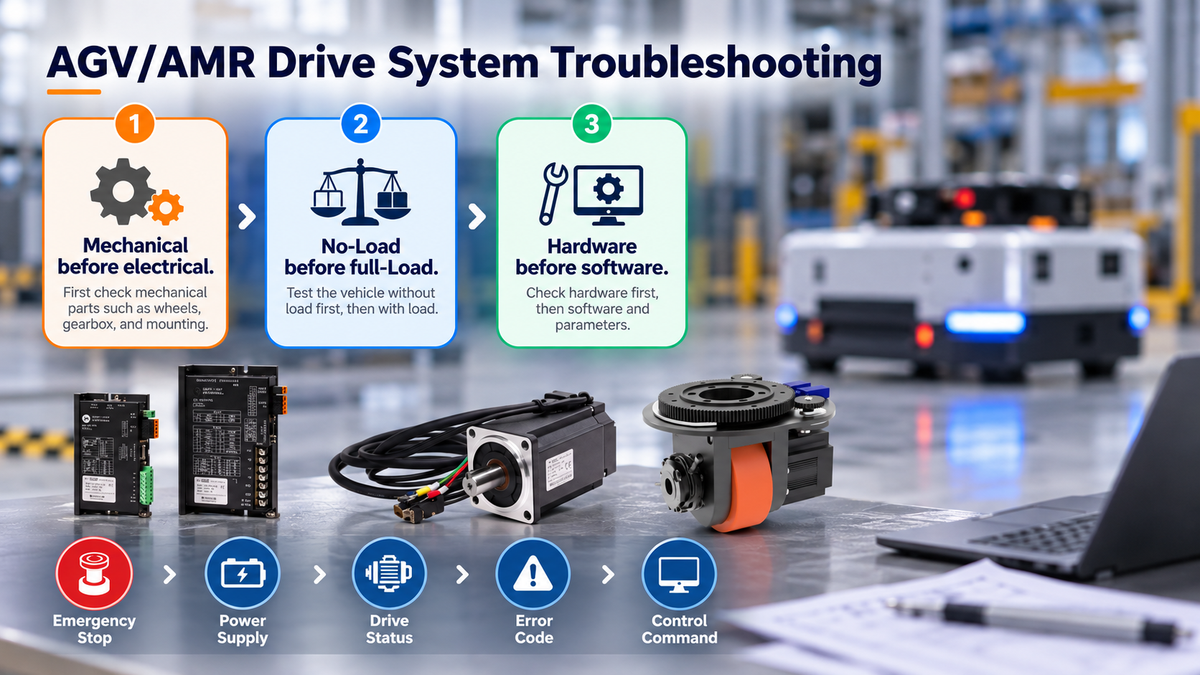
Check mechanical parts before tuning software. Test without load before testing at full load. Check hardware before changing control parameters.

Quick AGV/AMR Drive System Diagnosis
| Symptom | Possible Causes | Check First |
| AGV Does Not Move | E-stop, no drive power, servo alarm, no command | Safety circuit, power, drive status |
| AGV Pulls To One Side | Wheel speed mismatch, slipping, calibration, chassis issue | Drive wheels, encoder feedback, load balance |
| AGV Shakes Or Vibrates | Wheel damage, loose parts, gearbox wear, drive tuning | Wheels, mounting bolts, motor and gearbox |
| Abnormal Noise | Bearing, gearbox, foreign object, loose structure | Wheel and transmission parts |
| Drive Wheel Slips | Low traction, worn wheel, wet floor, poor load distribution | Wheel surface, floor, wheel pressure |
1. AGV Or AMR Does Not Move
If the vehicle is completely stationary, do not start by changing servo parameters.
Check the basic enable chain first.
Start with the emergency stop and safety signals. Make sure the local E-stop, remote E-stop, safety controller, and other interlock signals have been reset.
Then check whether the agv servo drive is powered and enabled. A disconnected contactor, blown fuse, low supply voltage, or drive fault can prevent the motor from running.
Also check the alarm information on the servo drive. Overcurrent, overvoltage, overload, encoder faults, or communication errors can stop the drive from enabling.
If the hardware looks normal, then check whether the controller is actually sending a motion command.
A practical check sequence is:
E-Stop → Power → Servo Drive Status → Alarm Code → Motion Command
Following the same order each time makes troubleshooting much faster.
2. AGV Runs But Does Not Travel Straight
If the AGV can move but slowly drifts to one side, the problem may come from the drive system or the chassis.
For differential-drive AGVs, the left and right agv differential drive wheels must run at closely matched speeds. Different motor parameters, encoder feedback, wheel diameter, or servo response can make one side travel slightly faster than the other.
Mechanical problems can create the same symptom.
One drive wheel may be slipping. The robot may have uneven weight distribution, and the wheel tread may be worn, or the chassis itself may not be aligned correctly.
A useful field test is to compare the vehicle under no-load and full-load conditions.
If it runs straight without load but starts drifting when loaded, pay more attention to traction, load distribution, motor torque, and wheel contact.
If the problem is present even without load, check wheel alignment, encoder feedback, motor parameters, and chassis geometry first.
3. AGV Shakes, Vibrates Or Makes Abnormal Noise
Vibration does not always mean the agv servo drive needs retuning.
Start with the mechanical parts.
Check the drive wheel for damage, flat spots, foreign objects, or uneven wear. Inspect the gearbox and bearings for abnormal play or metal noise. Also check whether the motor, steering drive wheel, gearbox, or chassis mounting bolts are loose.
If the mechanical system looks normal, then review the drive parameters.
Acceleration that is too aggressive, unsuitable speed-loop settings, poor inertia matching, or inconsistent parameters between two drive axes can cause low-speed shaking or resonance.
A simple field method is to listen to the sound, feel the vibration, and inspect the hardware before changing parameters.
If the noise changes with vehicle speed, wheel and gearbox components should be checked carefully. If the vibration mainly appears during acceleration, deceleration, or low-speed positioning, the servo drive and motor tuning may need further review.
4. AGV Drive Wheel Spins Or Slips
Wheel slip is one of the most common AGV/AMR drive problems.
Typical causes include wet or oily floors, worn polyurethane tread, insufficient load on the drive wheel, poor chassis weight distribution, or too much output torque for the available traction.
More motor torque does not always solve the problem.
Once the drive wheel loses grip, extra torque mainly makes the wheel spin faster.
Check the wheel surface first. Look for wear, cracks, contamination, or a polished tread surface. Then check whether enough vehicle weight is actually acting on the drive wheel.
For AGVs using suspension or floating drive-wheel structures, incorrect preload can also reduce traction.
Possible solutions include cleaning the floor, replacing worn wheels, changing wheel material or hardness, adjusting suspension pressure, and improving chassis weight distribution.
At HKT ROBOT, we have also encountered steering and traction problems in real AGV projects where floor conditions affected vehicle movement. The drive wheel, load, and actual working environment need to be evaluated together rather than looking at motor torque alone.
5. Quick Check Guide: Motor, Servo Drive, or Drive Wheel?
When the symptom is unclear, it helps to separate the system into three areas.
Check The Motor When
The motor overheats, produces weak torque, makes abnormal noise, or behaves differently under load.
Also check the motor if the current is unusually high or if the vehicle moves normally without load but becomes weak when carrying its rated payload.
Check The Servo Drive When
The drive reports alarms, the motor cannot enable, motion is unstable at low speed, acceleration or braking is inconsistent, or the command and feedback values do not match.
Before changing tuning parameters, always confirm the motor model, encoder settings, communication status, and basic wiring.
Check The Drive Wheel When
The AGV slips, pulls to one side, vibrates mechanically, produces wheel-related noise, or shows uneven tread wear.
Wheel diameter, polyurethane condition, bearing condition, installation alignment, load distribution, and floor friction can all affect vehicle movement.
The drive wheel is where motor torque finally reaches the floor, so a perfectly working motor and servo drive can still give poor vehicle performance if the wheel cannot maintain traction.

6. A Simple Field Troubleshooting Order
When an AGV or AMR develops a motion problem, a fixed troubleshooting sequence can save a lot of time.
Start with safety signals and power. Then inspect the drive wheels and mechanical installation. After that, check the motor and servo drive status, encoder feedback, and communication.
Only start changing control parameters after the basic hardware has been confirmed.
In short:
Mechanical before electrical. No-Load before full-Load. Hardware before software.
This approach helps avoid spending hours tuning software when the real problem is a worn drive wheel, loose mounting bolt, incorrect load distribution, or disconnected servo drive.
7. HKT ROBOT: AGV Components Provider Backed By Real Engineering Support
HKT ROBOT supplies agv steering drive wheels, differential drive wheels, servo motors, servo drives, precision gearboxes, controllers, caster wheels, and lifting and rotating modules for AGV and AMR manufacturers.
But supplying the right component is only part of the job. With more than 10 years of experience in mobile robot drive systems, we also understand the common problems that can appear during installation, commissioning, and daily operation, such as wheel slip, weak torque, overheating, vibration, steering errors, or drive alarms.
That means we can help customers not only select and match the right motor, drive, gearbox, and wheel, but also troubleshoot problems when the system does not perform as expected.
Needing AGV/AMR Drive Components? Send us your vehicle requirements and application details. We will help you select and match the right components for your project. And if you run into problems during installation, commissioning, or operation, our engineering team can also help you troubleshoot and find the next step.
For related info, you can also read:
Compartir:
AGV Steering Drive Wheel: Structure, Advantages, Applications, and Selection Guide
8 Key Factors to Consider When Selecting AGV Steering Drive Wheels