

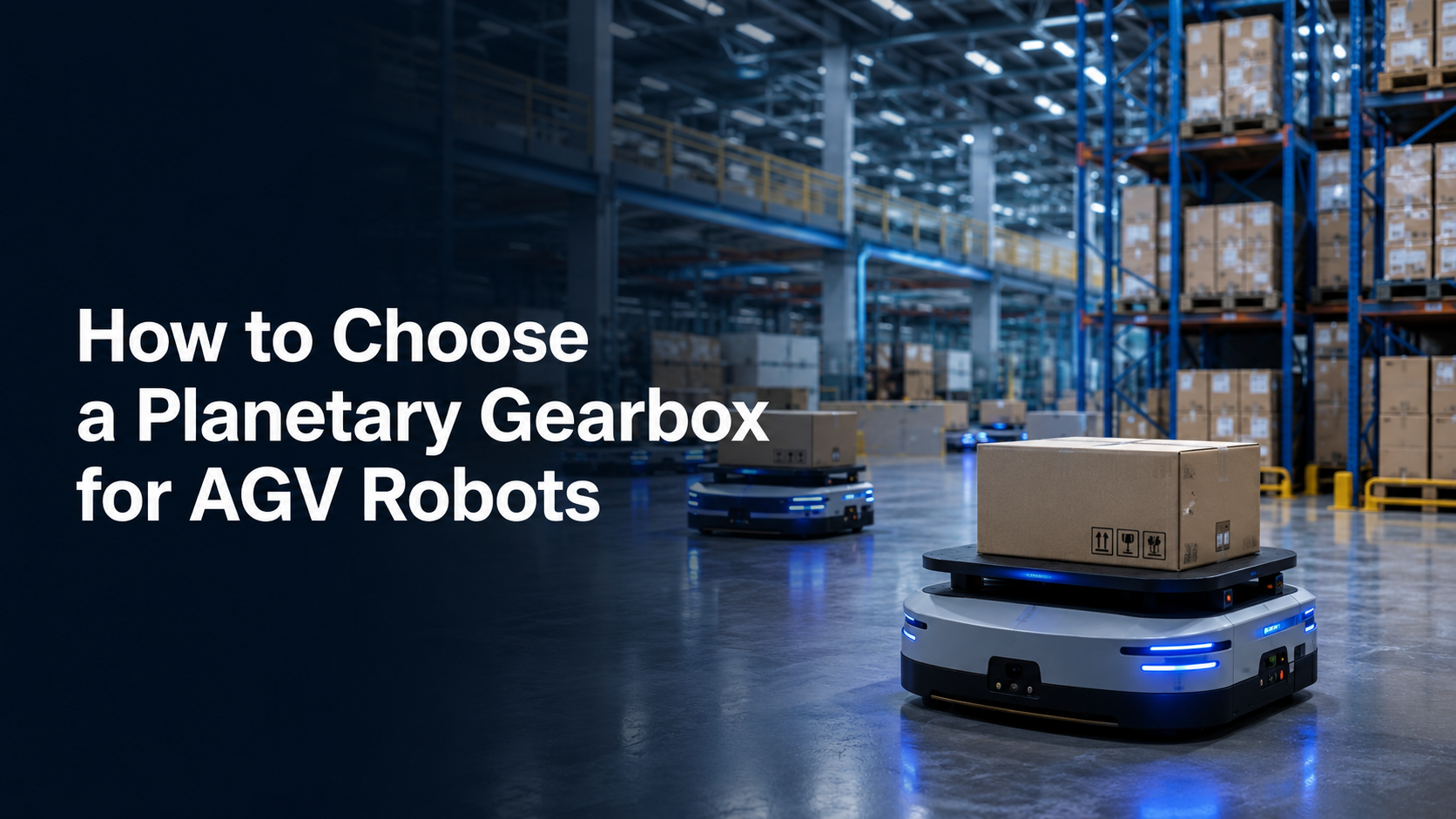
Automated Guided Vehicles and Autonomous Mobile Robots are only as precise as their weakest mechanical link. Navigation software can be flawless, sensor fusion can be state-of-the-art, and battery management can be optimized to the minute — but if the drivetrain gearbox introduces backlash, thermal instability, or inconsistent torque delivery, the entire system underperforms.
Among the various gearbox architectures available to robotics engineers, the planetary gearbox has become the dominant choice for AGV and AMR applications. Its combination of high torque density, coaxial form factor, and mechanical efficiency makes it uniquely suited to the space constraints and duty cycles that define modern warehouse automation.
This guide is written for mechanical engineers, procurement managers, and automation integrators evaluating drivetrain components for new AGV builds or retrofit projects. It covers how planetary gearboxes function within AGV drive systems, the specifications that matter most, how to align gear ratios with specific vehicle types, and what to look for when sourcing from an AGV gearbox manufacturer — including suppliers based in China.

What Is a Planetary Gearbox and How Does It Function in an AGV System
A planetary gearbox consists of three primary elements: a central sun gear, a set of planet gears arranged symmetrically around it, and an outer ring gear. In most configurations, the sun gear is driven by the motor shaft, the planet gears rotate around the sun while orbiting within the ring gear, and the output is taken from the planet carrier.
This architecture produces several properties that are directly valuable in AGV drivetrains.
High torque density in a compact envelope. Because the load is distributed across multiple planet gears simultaneously, a planetary gearbox can transmit significantly higher torque than a comparably sized spur or helical gearbox. For AGV wheel hubs — where available space is limited by wheel diameter and vehicle chassis height — this is a fundamental advantage.
Coaxial input and output. The input shaft and output shaft share the same centerline. This eliminates the offset that parallel-shaft gearboxes introduce, simplifying the mechanical integration between the drive motor and the wheel hub or drive axle.
High efficiency. Single-stage planetary gearboxes typically operate at 95–98% mechanical efficiency. Multi-stage units are slightly lower, but remain competitive against worm gear alternatives, which can drop below 70% efficiency — a meaningful difference in battery-powered AGV systems where energy budget is a design constraint.
Structural rigidity. The symmetric load distribution across planet gears reduces radial bearing loads on the output shaft, which translates to longer service life under the continuous, high-cycle duty common in 24/7 warehouse operations.
Core Technical Specifications Engineers Must Evaluate
Selecting a planetary gearbox for an AGV robot requires more than matching power ratings. The following parameters each affect drivetrain performance in ways that become apparent only after deployment.
Gear Ratio
Gear ratio determines the relationship between motor speed and output shaft speed. Higher ratios increase torque multiplication at the expense of output speed. For most AGV drive applications, gear ratios between 20:1 and 50:1 are typical — but the right ratio depends on motor characteristics, wheel diameter, vehicle speed requirements, and maximum payload. A common mistake is selecting a ratio based on peak torque requirements without accounting for starting inertia, ramp gradients, or dynamic load shifts during cornering.
Backlash
Backlash is the angular play between input and output when the direction of rotation reverses. In standard planetary gearboxes, backlash is typically expressed in arcminutes. For AGV positioning systems — particularly those using encoder feedback for closed-loop position control — excessive backlash directly degrades repeatability. Applications requiring high positioning accuracy should specify low-backlash or zero-backlash planetary gearboxes. Standard warehouse transport AGVs with looser positioning tolerances can accommodate higher backlash values.
Rated Output Torque and Peak Torque
Rated torque is the continuous operating torque the gearbox can sustain without damage. Peak torque covers momentary loads during acceleration, deceleration, or obstacle contact. Gearboxes should be sized with an appropriate service factor — typically 1.5 to 2.0 for AGV applications — applied to the calculated load torque.
Thermal Rating and Duty Cycle
Planetary gearboxes in continuous-duty AGV operations generate heat. The thermal rating defines the maximum ambient temperature and continuous power dissipation the unit can handle without exceeding lubricant degradation thresholds. For 24/7 operations or high-ambient environments such as foundries or outdoor AGVs, thermal management must be part of the specification process.
IP Rating and Sealing
Warehouse environments expose drivetrain components to dust, moisture, cleaning agents, and occasional liquid spills. Gearboxes used in food logistics, cold-chain warehouses, or outdoor yard AGVs require appropriate IP-rated seals. IP54 is a common minimum for indoor logistics; outdoor or washdown environments require IP65 or higher.
Mounting Interface Compatibility
The output flange and shaft dimensions of the gearbox must be compatible with the wheel hub, drive axle, or integrated steering module. Non-standard interfaces require custom adapters that add cost, weight, and potential failure points. Confirming interface compatibility early in the design process avoids expensive late-stage redesigns.

Matching Gear Ratios to AGV Application Types
Not all AGVs share the same drive requirements. The optimal planetary gearbox specification varies significantly by vehicle type.
Latent AMR and Lurking AGV
Latent AMRs operate by sliding beneath a payload shelf and jacking it upward. These vehicles typically carry payloads from 300 kg to 1,500 kg at moderate speeds of 1.0–1.5 m/s. Gear ratios in the 30:1 to 45:1 range are common, prioritizing torque over speed.
Forklift AGV
Powered pallet trucks and counterbalance AGVs carry the highest payloads — often exceeding 2,000 kg — and operate in mixed environments with gradients and load-shifting dynamics. Gearboxes for forklift AGV traction drives require high continuous torque ratings, robust thermal performance, and sealed designs to handle oil and debris typical in warehouse docks.
4-Way Shuttle
4-way shuttles require precise omnidirectional movement on rack lanes. Drive wheels must transition between longitudinal and lateral movement axes, imposing specific requirements on gearbox output shaft orientation and integration with horizontal steering wheel modules. Gear ratios are typically lower — 20:1 to 35:1 — to support faster lane speeds.
Sorting Robot
High-speed sorting robots operate with frequent start-stop cycles and rapid directional changes. Gearbox backlash and torsional rigidity are more critical here than in slower vehicles, as positioning errors compound across thousands of daily cycles.
Traction AGV
Towed load AGVs prioritize high pulling force over precision. Gear ratios at the higher end of the range — 40:1 to 60:1 — are common, and gearbox sizing is driven by drawbar pull calculations rather than vehicle weight alone.
How Planetary Gearboxes Integrate with AGV Drive Wheel Systems
In modern AGV drive modules, the planetary gearbox typically integrates directly into the wheel hub assembly. This arrangement — commonly called an integrated drive wheel or hub-drive module — eliminates external transmission shafts, reduces the number of mechanical interfaces, and simplifies chassis integration.
A well-designed integrated drive wheel incorporates the servo motor, planetary gearbox, wheel hub, and encoder into a single bolt-on unit. The coaxial nature of the planetary gearbox makes this integration mechanically clean: the motor shaft feeds directly into the gearbox sun gear, and the output connects to the wheel hub with minimal intervening structure.
For engineers who require more flexibility — for example, when retrofitting existing chassis designs or when wheel geometry dictates a non-standard configuration — split drive wheel kits are available. In these configurations, the motor and gearbox are separate assemblies connected via a coupling or short shaft, allowing each component to be sourced, replaced, or upgraded independently.
In either case, the interface between the gearbox output and the drive wheel must handle both radial and axial loads resulting from vehicle weight distribution, cornering forces, and uneven floor surfaces. Gearbox output bearing specifications should be reviewed against the actual load cases of the intended application.
What to Look for in an AGV Gearbox Manufacturer in China
China has developed a substantial industrial base for AGV drivetrain components, with several manufacturers offering planetary gearboxes that meet international quality standards at competitive cost points. However, the range in quality and engineering capability across suppliers is wide. Evaluating potential partners requires looking beyond catalogue specifications.
In-house R&D and application engineering. The best manufacturers employ engineers who understand AGV system integration, not just gear geometry. A supplier capable of reviewing your application requirements — motor interface, duty cycle, load profile, environmental conditions — and recommending an appropriate configuration adds substantial value over a catalogue supplier.
Customization capability. Standard catalogue gearboxes rarely fit every application perfectly. Gear ratio, output flange pattern, shaft dimensions, sealing grade, and backlash class all benefit from customization. Assess whether the manufacturer can produce application-specific configurations without prohibitive minimum order quantities.
Certifications and quality systems. ISO 9001 certification indicates a documented quality management system governing production. CE marking confirms compliance with EU machinery safety directives, relevant for products destined for European automation projects. Requests for dimensional inspection reports and test data should be met without hesitation by a credible manufacturer.
Warranty and technical support. A manufacturer offering a two-year warranty on drivetrain components signals confidence in production quality. Equally important is the availability of responsive technical support after shipment — for AGV manufacturers running continuous operations, downtime caused by delayed support responses has real financial consequences.
Production capacity and lead time. For volume AGV production programs, consistent supply is as important as component quality. Evaluate whether the manufacturer's production capacity aligns with your program ramp requirements.

Common Engineering Mistakes When Selecting an AGV Gearbox
Even experienced engineers make specification errors that become apparent only after deployment.
Undersizing based on static load calculations. Dynamic loads — particularly starting torque, emergency braking, and obstacle impacts — frequently exceed static load estimates by 1.5 to 3 times. Gearboxes sized to static calculations without an adequate service factor will experience premature wear or failure.
Ignoring backlash in applications with positioning feedback. Standard gearboxes may be adequate for basic transport runs, but low-backlash variants are necessary whenever the control system relies on encoder feedback for position accuracy. Specifying a standard gearbox for a precision positioning application is a specification error, not a cost saving.
Selecting gear ratio without considering motor operating point. The gear ratio determines where the motor operates on its torque-speed curve under typical load conditions. A ratio that places the motor consistently near its peak torque output reduces efficiency and accelerates thermal degradation.
Overlooking mounting interface until late in the design cycle. Output flange dimensions, shaft diameter, and bolt pattern should be confirmed against the wheel hub interface at the beginning of component selection, not after the mechanical design is finalized.
FAQ
What gear ratio is best for a standard warehouse AGV robot?
There is no universal answer, as the optimal gear ratio depends on motor rated speed, wheel diameter, target vehicle speed, and maximum payload. As a general starting point, gear ratios between 30:1 and 45:1 cover a wide range of warehouse AMR and AGV applications. The correct approach is to calculate required wheel torque from the load and gradient requirements, then select a ratio that satisfies both within the motor's continuous operating envelope.
Can planetary gearboxes be customized for non-standard AGV designs?
Yes. Reputable manufacturers can produce gearboxes with custom gear ratios, output flanges, shaft dimensions, and sealing specifications. For volume production programs, application-specific configurations are both technically feasible and economically practical.
How long does a planetary gearbox last in 24/7 AGV operations?
Service life depends heavily on application load, ambient conditions, lubrication quality, and whether the gearbox was correctly sized for the duty cycle. Well-specified planetary gearboxes from quality manufacturers typically achieve 20,000 to 40,000 hours of service life in standard indoor warehouse environments. Premature failure is almost always traceable to undersizing, contamination ingress, or lubrication breakdown.
Is CE or ISO 9001 certification required for AGV gearboxes?
Requirements depend on the destination market and end application. For AGV systems deployed in EU member states, CE marking on the complete machine is required, and component certifications contribute to the overall compliance documentation. ISO 9001 certification of the component manufacturer provides assurance that production processes are controlled and documented — relevant for procurement risk management in any market.
Conclusion
The planetary gearbox is not a commodity component in AGV drivetrain design — it is a precision mechanical element that directly determines positioning accuracy, payload capacity, energy efficiency, and operational lifespan. Getting the specification right requires understanding gear ratio selection, backlash requirements, thermal performance, and integration with the wider drive system.
For engineering teams sourcing drivetrain components for new AGV programs, the evaluation of an AGV gearbox manufacturer should go beyond catalogue specifications. Production capability, application engineering support, certification credentials, and post-sale service response all affect the real-world performance of the deployed system.
A well-specified planetary gearbox, properly integrated with the drive motor and wheel system, is the mechanical foundation on which reliable AGV automation is built.
Share:
Common AGV Servo Drive Problems and How to Avoid Them
The Challenge Of AGV Steering Wheel Selection: How To Find The Best Fit In Complex Requirements