

A standard drive wheel may provide enough torque, but its motor and gearbox can make the chassis too tall. Using a smaller wheel may reduce the height, but it can also affect ground clearance, traction, wheel life, and the robot’s ability to pass over floor joints.
For this reason, many underbody and latent AGV/AMR projects require a low profile AGV drive unit designed around the actual chassis space rather than a standard off-the-shelf wheel assembly.

What Is a Low-Profile AGV Drive Unit?
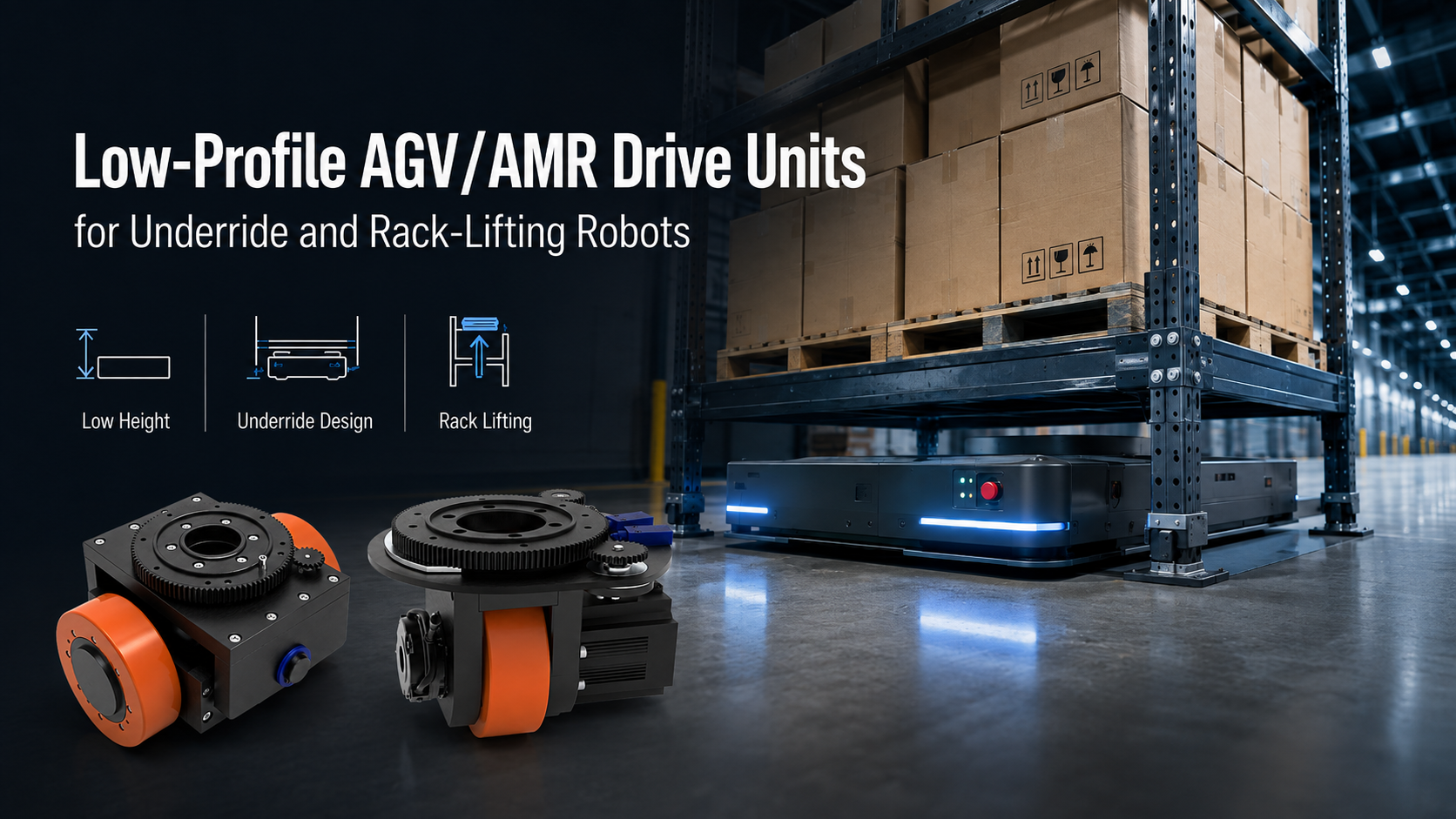
A low-profile drive unit is a compact assembly that combines the motor, gearbox, drive wheel, encoder, brake, and mounting structure within a limited installation height.
In a conventional drive unit, the motor may be installed above the wheel. This layout is simple, but it takes up valuable vertical space. In a low-profile design, the motor is usually installed horizontally beside the wheel, allowing the main body of the drive unit to sit lower inside the chassis.
This type of layout is commonly used in underbody AMRs, latent AGVs, lifting robots, rack-moving robots, and other mobile platforms that must operate below a load.
The purpose is not simply to make the drive unit smaller. It must still provide enough torque, load capacity, braking force, and operating life for the complete vehicle.
Why Installation Height Matters
For an underbody AGV/AMR, a few millimeters can affect the whole mechanical layout.
If the drive unit is too tall, the designer may need to raise the upper chassis, reduce the battery size, change the lifting module, or lower the ground clearance. Any of these changes can affect the final vehicle performance.
This is why the installation height should be checked at the beginning of the chassis design rather than after the frame has already been completed.
The wheel diameter is only one part of the total height. The motor position, gearbox structure, mounting plate, encoder, brake, connector direction, and suspension design can all affect the final space requirement.
Two drive units with the same wheel diameter may have very different overall dimensions. A proper comparison should therefore be based on the complete assembly drawing, not only the wheel specification.
How a Horizontal Motor Layout Saves Space
A horizontal motor layout places the motor beside the wheel instead of directly above it.
The motor transfers power to the wheel through a planetary gearbox, right-angle gearbox, parallel-shaft structure, or another compact reduction system. This arrangement reduces vertical height and makes better use of the horizontal space inside the chassis.
For many low-floor robots, this can leave more room above the drive unit for the battery or lifting mechanism.
However, a low unit is not automatically an easy unit to install. The motor may extend farther into the chassis, and the cables still need enough bending and maintenance space. The designer must therefore consider the complete length, width, height, and connector position.
A well-designed low height AGV steering wheel or horizontal drive assembly should fit the available space without making future maintenance difficult.
Choosing the Right Wheel Diameter
It may seem logical to use the smallest possible wheel when building a low chassis, but this can create new problems.
A smaller wheel lowers the axle position, yet it also reduces ground clearance and makes the robot more sensitive to floor gaps, expansion joints, cables, and uneven surfaces. It usually needs to rotate faster at the same vehicle speed and may place higher demands on the motor and gearbox.
A larger wheel normally runs more smoothly over imperfect floors and can offer better durability, but it requires more vertical space.
The best wheel diameter depends on the actual working environment. A compact wheel may perform well on a smooth warehouse floor, while a factory with joints, ramps, or uneven areas may require a larger diameter.
The goal should be the lowest reliable chassis, not simply the lowest possible chassis.
Load Capacity, Traction, and Wheel Pressure
The total vehicle weight should not be divided equally by the number of wheels without checking the chassis layout.
The actual load on each drive wheel depends on the position of the battery, payload, lifting module, drive wheels, and caster wheels. The center of gravity also changes when the robot carries or lifts a load.
An underbody AMR drive wheel must carry enough weight to create traction. If the wheel pressure is too low, it may slip during acceleration, braking, turning, or ramp climbing. If the wheel carries too much weight, the polyurethane tread, bearings, gearbox, and mounting structure may wear faster.
This balance is particularly important for lifting AMRs. When the load is raised, the center of gravity and wheel-load distribution may change. The drive unit should therefore be selected based on both the empty and fully loaded condition.
Matching the Motor and Gearbox
A compact drive unit still needs enough torque to start, accelerate, turn, and stop the robot under full load.
Motor selection should consider the total moving weight, wheel diameter, target speed, acceleration, floor resistance, slope, and working cycle. The gearbox must then convert the motor speed into the required wheel speed and output torque.
A higher gear ratio increases wheel torque but reduces the maximum speed. A lower ratio allows faster travel but may not provide enough force under heavy load.
For a latent AGV drive system, the motor and gearbox should be selected together. Looking only at motor power can be misleading. Continuous torque, peak torque, gearbox efficiency, operating temperature, and duty cycle are often more important than the power number printed on the motor label.
A drive unit may perform well during a short test but overheat during continuous warehouse operation. This is why the real working cycle should be included during selection.
Differential Drive or Steering Drive?
Many low-profile AMRs use a differential drive layout with two powered wheels. The vehicle turns by changing the speed and direction of the left and right wheels.
This structure is compact, simple, and cost-effective. It is widely used in rack-moving robots, latent AGVs, and underbody AMRs that follow regular indoor routes.
A steering drive unit combines driving and steering in one module. It can provide more flexible movement, accurate docking, and better control in narrow spaces. It is suitable for vehicles that need dual-steering, four-steering, or multi-directional movement.
However, a steering drive includes more components, such as the drive motor, steering motor, gearbox, encoder, and rotary structure. Producing a compact low height AGV steering wheel is therefore more complex than producing a differential drive wheel.
The choice should be based on the required movement pattern, not only the chassis height.

Typical Applications
Low-profile drive units are commonly used in robots that must travel below or inside another structure.
An underbody AMR may move below a rack or cart and lift it using a jacking module. In this design, the drive system must leave enough room for the lifting mechanism while keeping the wheel and motor protected inside the chassis.
A latent AGV usually enters beneath a load carrier before lifting or towing it. Its drive system needs compact dimensions, stable low-speed control, reliable braking, and enough wheel torque for frequent starting and stopping.
Rack-moving robots also work for long hours and complete repeated turning and docking movements. For these vehicles, gearbox life, motor temperature, wheel wear, and encoder accuracy are just as important as installation height.
The same design approach can also be used for compact transfer robots, low-floor warehouse vehicles, and lifting AMRs used in production lines.
Common Design Problems
One common mistake is selecting a drive unit only by its rated load. Static load capacity does not show whether the motor has enough torque for acceleration, slope climbing, or frequent turning.
Another mistake is reducing the wheel diameter too far. The chassis becomes lower, but the robot may experience more vibration, faster wheel wear, or poor performance on floor joints.
Cable space is also easy to overlook. Motor, brake, and encoder connectors need enough room for installation and bending. A drive unit that fits inside the CAD model may become difficult to install once the cables are connected.
The safest approach is to confirm the drive-system layout before finalizing the chassis frame.
Selecting a Low-Profile Drive Unit
A supplier normally needs more than the total vehicle weight to recommend the right model.
The most useful information includes the empty vehicle weight, maximum payload, required speed, acceleration, slope, wheel diameter limit, maximum installation height, available motor space, system voltage, brake requirement, encoder type, floor condition, and communication protocol.
A 2D chassis drawing or 3D model can make the selection much faster. It allows the supplier to check the wheel position, motor direction, mounting holes, cable outlets, and service space before the customer completes the vehicle design.
Low-Profile Drive Solutions from HKT ROBOT
HKT ROBOT provides drive components and integrated solutions for AGV and AMR projects, including horizontal steering drive units, differential drive wheel assemblies, servo motors, gearboxes, servo drives, controllers, and lifting modules.
For low-floor projects, the motor, gearbox, wheel diameter, gear ratio, brake, encoder, and installation structure can be matched according to the available chassis space and vehicle performance requirements.
Instead of selecting the motor, gearbox, and wheel separately, HKT ROBOT can help evaluate them as one complete drive system.
For an initial recommendation, customers can provide the vehicle weight, payload, target speed, maximum installation height, preferred wheel diameter, system voltage, floor condition, and chassis drawing.
A suitable low profile AGV drive unit should do more than fit into a small space. It should provide the torque, traction, control accuracy, and operating life required by the complete AMR.

Frequently Asked Questions
What makes an AGV drive unit low profile?
A low-profile drive unit normally uses a compact gearbox and a horizontal motor layout to reduce the vertical installation height. The final height also depends on the mounting structure, wheel diameter, brake, encoder, and cable position.
Is a smaller wheel always better for a low chassis?
No. A smaller wheel can reduce the chassis height, but it also reduces ground clearance and may perform poorly on uneven floors or expansion joints.
Can a low-profile drive unit carry heavy loads?
Yes, but the motor, gearbox, bearings, wheel material, and mounting structure must be selected according to the actual wheel load and working cycle.
Is differential drive suitable for latent AGVs?
Yes. Differential drive is commonly used in latent AGVs and underbody AMRs because it offers a compact structure, simple control, and relatively low cost.
Can HKT ROBOT customize the drive-unit dimensions?
HKT ROBOT can match the wheel diameter, motor power, gearbox ratio, voltage, brake, encoder, communication interface, and mounting structure according to the project requirements.
Share:
AGV/AMR Steering Drive vs. Differential Drive: Performance Comparison and Selection Guide
AGV Servo Motor Commissioning: Common Setup and Tuning Issues