

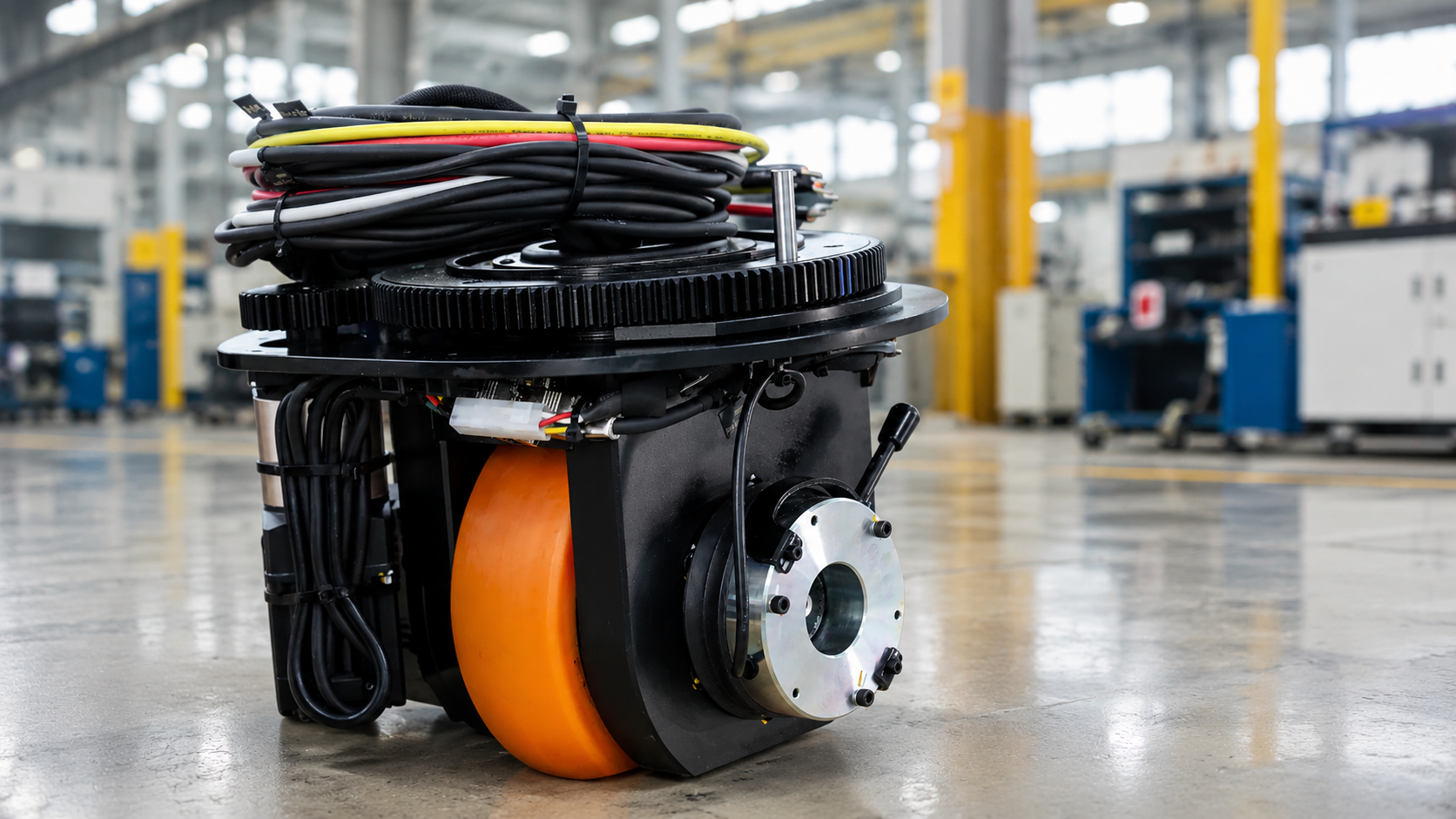
AGV steering wheel is a key motion unit in an AGV/AMR chassis. It supports forward and backward movement, steering, load carrying, position feedback, control response, installation layout, and long-term maintenance.
In many AGV projects, a steering wheel may look like a simple combination of a wheel, motor, and gearbox. But during prototype testing or real site operation, issues such as slipping, unstable steering, insufficient torque, limited installation space, control delay, or fast wheel wear may appear.
Understanding the structure and working principle of an AGV steering wheel is therefore not only about knowing how the product works. It also helps engineers judge whether the selected module truly matches the vehicle structure, payload condition, floor environment, and control system.

Basic Structure Of An AGV Steering Wheel Module
An AGV steering wheel module usually includes two main parts: the travel drive unit and the steering unit.
The travel drive unit provides traction force for forward and backward movement. It usually includes a travel motor, gearbox, rubber-coated wheel, brake, and feedback unit.
The steering unit controls the wheel direction. It usually includes a steering motor, steering gearbox, steering gear, rotary structure, encoder or feedback unit, and limit protection mechanism.
Although the basic structure may look similar, different models can vary in mounting hole layout, installation height, wheel diameter, gear ratio, motor specification, encoder type, and communication interface. For this reason, the steering wheel should be reviewed together with the actual AGV chassis design.

How Drive And Steering Work Together
The travel motor outputs torque through the gearbox, and the rubber-coated wheel transfers this force to the floor. This allows the AGV to move forward, move backward, and control travel speed.
In real applications, the travel drive unit must match the vehicle weight, payload, acceleration, slope requirement, floor friction, and operating frequency. If the torque margin is not enough, the AGV may slip, vibrate, or respond slowly during startup, turning, braking, or climbing.
The steering unit changes the wheel angle according to commands from the control system. Through the steering motor, gearbox, and gear transmission, the module rotates to the required direction. For dual-steering-wheel or multi-steering-wheel AGVs, several modules need to work together through the control algorithm.
For narrow aisles, pallet docking, warehouse logistics, or high-precision positioning, the steering wheel module should not only be able to turn. It also needs to turn accurately, stop smoothly, and provide consistent feedback.
Why Feedback And Limit Protection Matter
An AGV steering wheel module usually includes a feedback unit to report the current steering angle to the control system. Accurate feedback helps the vehicle maintain direction and follow the planned path.
Electronic or mechanical limit protection helps prevent the steering angle from exceeding the safe range. Under normal conditions, the module should not frequently reach the mechanical limit. Mechanical limit protection is mainly used for abnormal situations such as program errors, sensor failure, or electronic limit failure.
These details may seem small, but they directly affect reliability. If feedback is inaccurate, the vehicle may drift from its path. If limit protection is poorly designed, the steering motor, gears, or mechanical structure may be damaged.
Why Selection Should Not Be Based Only On Specifications
Many projects start selection by checking rated load, speed, wheel diameter, and external size. These parameters are important, but they are not enough.
A higher payload does not only mean choosing a module with a higher rated load. Engineers also need to consider load distribution, center of gravity, acceleration impact, braking force, turning force, and safety margin.
A higher speed requirement does not simply mean using a faster motor. It may also affect gear ratio, torque output, braking distance, control stability, and wheel wear.
Installation space and floor condition are also important. Even if the specifications look suitable, the module may still be difficult to use if installation height, rotating clearance, mounting holes, cable outlet direction, or maintenance space does not match the vehicle design. Floors such as epoxy, concrete, cold storage, dusty areas, or oily surfaces may also require different wheel materials and protection levels.
This is why HKT Robot does not recommend a steering wheel module only by rated load or wheel diameter. We review vehicle weight, payload, speed, floor condition, installation space, and control requirements together before suggesting a suitable model or customized direction.
What HKT Robot Can Support
HKT Robot focuses on AGV/AMR drive system components, including AGV steering wheel modules, drive wheels, 48V servo motors, servo drives, controllers, and lifting and rotating modules.
Based on different vehicle platforms and application scenarios, HKT Robot can support:
- Wheel diameter and rubber-coated wheel material selection
- Load capacity and safety margin matching
- Speed, torque, and gear ratio evaluation
- Installation height, mounting structure, and cable outlet review
- 48V servo motor and servo drive matching
- Encoder and feedback method selection
- Brake and limit protection configuration
- CANopen, EtherCAT, or other control interface evaluation
- Integrated matching with controllers, drive wheels, and lifting modules
For AGV manufacturers, system integrators, or customers developing new mobile robot platforms, HKT Robot can support not only a single steering wheel module, but also the matching of the complete AGV/AMR drive system.
What Information Helps Us Recommend The Right Module
To evaluate the right AGV steering wheel module or customized drive solution, customers can provide:
- AGV/AMR vehicle type
- Vehicle weight and maximum payload
- Number of steering wheel modules and chassis layout
- Target speed, acceleration, and slope requirement
- Floor condition and operating environment
- Installation space, mounting holes, and cable outlet direction
- Control system and communication protocol requirements
- Whether the module needs to work with lifting or rotating mechanisms
- Noise, wheel wear, maintenance cycle, and spare parts requirements
The more complete the project information is, the easier it is to recommend a suitable steering wheel model, drive configuration, or customization direction. It also helps reduce redesign, commissioning, and after-sales risks.
Conclusion
An AGV steering wheel module may look compact, but it involves drive, steering, load support, feedback, control, installation, and maintenance.
A suitable AGV steering wheel solution should not only make the vehicle move. It should help the AGV operate reliably in real working conditions, support stable control, simplify commissioning, and make long-term maintenance easier.
If your project is in the stage of AGV/AMR chassis design, steering wheel selection, or drive system matching, you can send HKT Robot your vehicle weight, payload, target speed, floor condition, installation drawing, and control protocol requirements. Our team can review the steering wheel model, drive configuration, motor and drive matching, controller requirements, and possible customization direction before quotation.
Share:
The Challenge Of AGV Steering Wheel Selection: How To Find The Best Fit In Complex Requirements
AGV Lifting Mechanism: How It Works and How to Choose One