

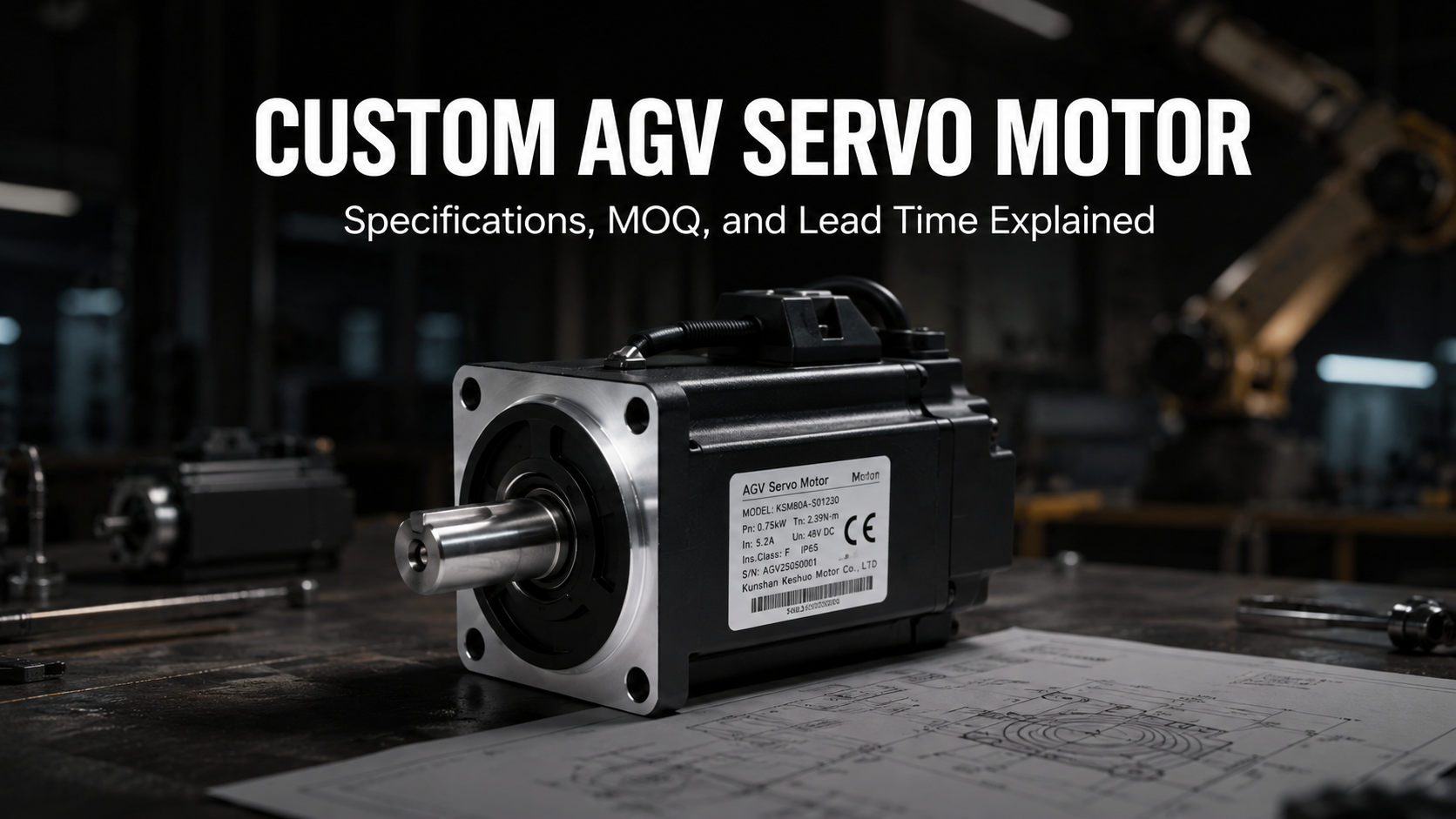
Ordering a custom AGV servo motor is a different process than selecting a part number from a catalog. Instead of matching an off-the-shelf spec sheet to your application, you are defining requirements from the ground up — which means the buyer, not just the supplier, needs to understand what information matters, how minimum order quantities work for custom builds, and what a realistic timeline looks like from first inquiry to delivered units. This guide walks through what to prepare before requesting a quote, how MOQ and lead time typically work for custom AGV servo motors, and the mistakes that most often delay a project or add unplanned cost.

Why Buyers Choose a Custom AGV Servo Motor Over a Standard Model
Standard catalog motors cover a wide range of AGV applications, but they do not cover all of them. Understanding why customization becomes necessary helps clarify whether your project actually needs it.
Common Reasons for Customization
Buyers typically move to a custom AGV servo motor when a standard unit does not fit the available installation space, when the required voltage or torque falls between standard offerings, when a specific encoder type or communication protocol is needed to match an existing controller, or when connector type and cable routing must match an existing chassis design. In some cases, the driver is regulatory or customer-specific — an end customer may require a particular certification, connector standard, or branding that a catalog part cannot provide.
Standard vs Custom: When Customization Is Actually Necessary
Not every project that feels unique actually requires a fully custom motor. Many requirements — a specific gear ratio, a particular encoder resolution, an alternate shaft length — can often be met by configuring options within an existing product family rather than designing a new motor from scratch. True customization, which typically involves new tooling or a redesigned housing, makes sense when the application's constraints cannot be met by any configuration of existing product lines. Clarifying this distinction early can significantly change both MOQ and lead time expectations.
What Specifications to Define Before Requesting a Custom AGV Servo Motor
The quality of a custom motor quote depends directly on the quality of the specifications provided. Incomplete requirements are the single most common cause of quote delays and rework.
Electrical Parameters
Suppliers need supply voltage, rated power, rated and peak torque, rated speed, and rated current at minimum. If the motor will operate under variable load or duty cycle conditions rather than constant load, providing a duty cycle profile — not just peak values — allows for more accurate motor sizing.
Mechanical Parameters
Flange size, shaft diameter and length, mounting hole pattern, overall length constraints, and weight limits all affect whether a motor can physically integrate into an existing chassis. For AGV applications, installation space is often the tightest constraint, so providing a mechanical drawing or 3D model of the mounting area early avoids late-stage redesign.
Feedback and Communication
Specify whether the application requires an incremental or absolute encoder, the required resolution, and the communication protocol the motor controller expects — such as CANopen, Modbus, or a specific serial interface. Mismatched communication protocols are a common source of integration delays discovered only after motors arrive.
Environmental and Application Requirements
Ambient temperature range, required IP protection rating, expected duty cycle, and typical load profile all influence both the motor design and its long-term reliability. Buyers who omit environmental requirements often receive a motor that performs well in testing but underperforms in the actual operating environment.

Understanding MOQ for Custom AGV Servo Motors
Minimum order quantity is one of the first questions buyers ask, and one of the least standardized answers in the industry, since it depends heavily on how much true customization is involved.
Why MOQ Exists for Custom Builds
Custom motors often require new tooling, unique wiring harnesses, or dedicated encoder configurations that are not cost-effective to produce in very small batches. MOQ reflects the point at which the fixed costs of customization — tooling, engineering time, and initial setup — can be reasonably spread across a production run.
Typical MOQ Ranges and What Affects Them
Configuration-level customization, such as selecting an encoder option or adjusting a gear ratio from existing product options, generally carries a lower MOQ than true custom design work involving new mechanical tooling. Projects requiring new housings, custom flanges, or fully bespoke electrical designs typically carry higher MOQ thresholds to justify the non-recurring engineering cost.
Ways to Reduce MOQ Barriers
Buyers with lower initial volume needs can often reduce MOQ requirements by favoring configuration-based customization over full custom design, by combining requirements across multiple projects into a single order, or by accepting a longer lead time in exchange for a smaller initial batch. Discussing volume expectations honestly and early, including anticipated future orders, often gives suppliers more flexibility on MOQ than a first-order request alone.
Lead Time for Custom AGV Servo Motor Orders
Lead time for a custom AGV servo motor is rarely a single number — it is the sum of several distinct stages, each with its own risk of delay.
Design and Sample Stage
This stage covers specification review, mechanical and electrical design work, and production of initial samples. Depending on the extent of customization, this stage can range from a couple of weeks for configuration-level changes to several weeks for a fully custom design requiring new drawings and engineering review.
Tooling and Mass Production Stage
Once samples are approved, any new tooling required for mass production is finalized, followed by the first production run. This stage is typically the longest portion of the overall timeline for fully custom designs, since tooling lead time is largely fixed regardless of order urgency.
Factors That Extend or Shorten Lead Time
Incomplete specifications, multiple rounds of sample revisions, and component shortages for specialized encoders or connectors are the most common causes of extended lead time. On the other hand, providing complete documentation up front, approving samples promptly, and choosing configuration-based rather than fully custom options generally shortens the overall timeline.
The Custom Ordering Process Step by Step
Understanding the sequence of a custom order helps buyers plan internal timelines and set realistic expectations with their own customers.
Submitting Technical Requirements
The process typically begins with a technical requirement document or drawing covering the electrical, mechanical, and environmental parameters outlined earlier. The more complete this submission, the faster a supplier can return an accurate quote and timeline.
Sample Evaluation and Approval
Suppliers produce one or more samples for the buyer to test in an actual or simulated application environment. This step is critical — approving a sample without real-world testing is one of the most common ways issues surface only after mass production has already begun.
Mass Production and Quality Control
After sample approval, the order moves into mass production, typically with defined quality control checkpoints such as incoming material inspection, in-process testing, and pre-shipment inspection. Buyers should confirm what quality documentation will be provided with the shipment, particularly for regulated industries or end customers with their own compliance requirements.

Common Mistakes Buyers Make When Customizing an AGV Servo Motor
Most delays and cost overruns in custom motor orders trace back to a small set of recurring mistakes.
Underspecifying Environmental Conditions
Buyers frequently provide electrical and mechanical specifications in detail but leave out ambient temperature range, dust or moisture exposure, or duty cycle information. These factors directly affect component selection and are difficult to correct after tooling has been finalized.
Ignoring Total Cost Beyond Unit Price
Unit price alone does not capture tooling costs, sample fees, or the cost of potential redesign if specifications change mid-project. Buyers who evaluate quotes on unit price alone sometimes find that a lower quoted price comes with higher total project cost once these factors are included. A broader look at how motor and drive system components interact is covered in this guide to servo motor selection for precise and efficient control.
Skipping Sample Testing Before Bulk Order
Under time pressure, some buyers approve samples based on datasheet review alone rather than testing them in the actual application. This significantly increases the risk of discovering a mismatch — in torque, thermal behavior, or encoder compatibility — only after a full production batch has already been manufactured.
FAQ
What is a typical MOQ for a custom AGV servo motor?
MOQ varies widely depending on the extent of customization. Configuration-level changes within an existing product family typically carry a lower MOQ than fully custom designs requiring new tooling, which is why clarifying the type of customization needed early is important for setting accurate expectations.
How long does it take to get a custom AGV servo motor?
Total lead time depends on design complexity, sample revision cycles, and whether new tooling is required. Configuration-based customization is generally faster than fully custom mechanical designs, and providing complete specifications up front is one of the most effective ways to shorten the overall timeline.
Can I get a sample before committing to a full order?
Most suppliers offer a sample stage before mass production specifically so buyers can validate performance in their own application before committing to a full batch. Skipping this step to save time is one of the more common causes of costly rework later.
What information should I include in an initial custom motor inquiry?
At minimum, include voltage, rated power and torque, speed, mounting dimensions, encoder type, communication protocol, environmental conditions, and expected order volume. The more complete this information, the faster and more accurate the resulting quote will be.
Does a lower MOQ always mean a better deal?
Not necessarily. A lower MOQ sometimes comes from limiting customization to configuration-level changes rather than a full custom design, which may or may not meet your actual requirements. It is worth confirming exactly what level of customization a given MOQ applies to before comparing offers.
Conclusion
A custom AGV servo motor project moves faster and more predictably when buyers understand what suppliers actually need to quote accurately — complete electrical, mechanical, and environmental specifications, a realistic view of order volume, and a willingness to validate samples before committing to mass production. MOQ and lead time are not fixed numbers; they shift significantly based on how much true customization is involved versus configuration within existing product options. Approaching the process with complete documentation and clear expectations from the first inquiry is the most reliable way to avoid delays and unplanned cost later in the project.
Share:
AGV Drive Motor Encoder Selection: Incremental vs Absolute Encoders
Reliable AGV Motor for AGV/AMR Applications