

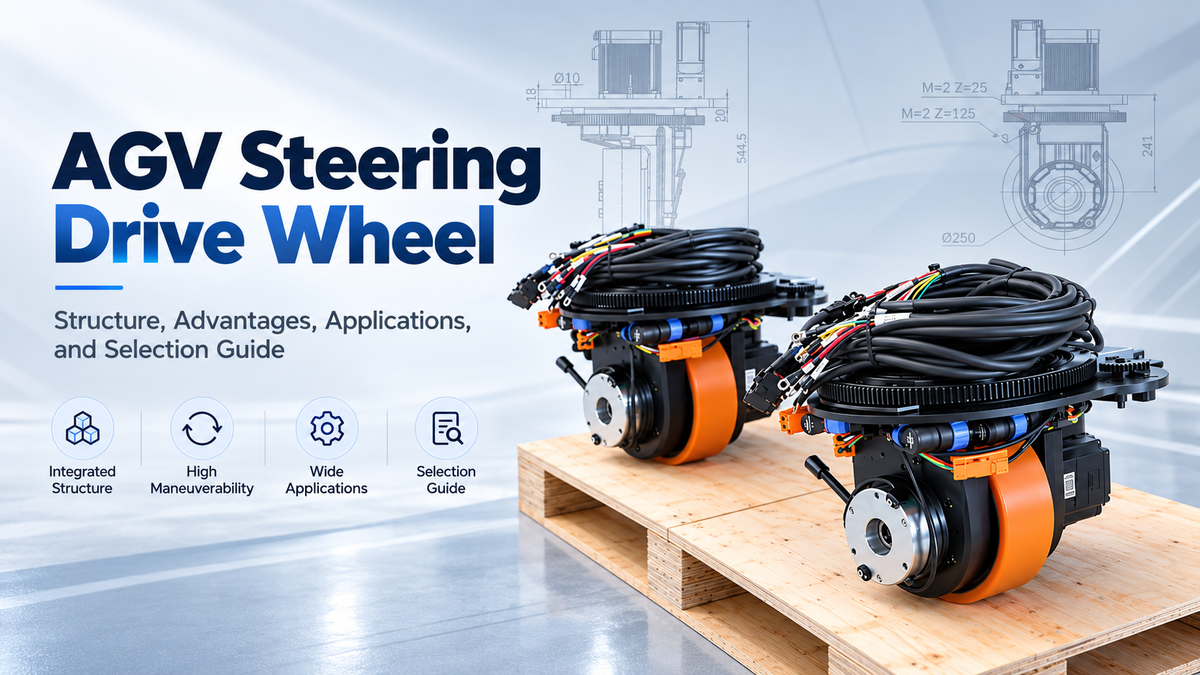
As smart warehousing, flexible manufacturing, and automated logistics continue to grow, AGVs, AMRs, autonomous forklifts, and heavy-duty mobile robots need better drive systems.
A drive system must provide enough traction. But that is not enough. It also needs good steering accuracy, stable low-speed movement, suitable installation space, and reliable vehicle control.
An AGV steering drive wheel combines travel drive and active steering in one module. It controls both the travel speed and wheel direction. Because of this, it is widely used in mobile robots and autonomous forklifts.

What Is an AGV Steering Drive Wheel?
An AGV steering drive wheel is a modular drive unit that combines driving, steering, reduction, feedback, and mounting interfaces.
Unlike a fixed drive wheel, it can do more than move forward and backward. It can also actively change the wheel direction.
Depending on the number of steering drive wheels and the control method, the vehicle can turn, rotate in place, and move in different directions.
An integrated steering drive wheel also makes chassis design easier. Instead of selecting the motor, gearbox, wheel, and steering mechanism separately, manufacturers can use one complete drive module. This reduces matching work and makes installation and commissioning more straightforward.
At HKT ROBOT, we provide different AGV steering drive wheel solutions, including vertical steering drive wheels, horizontal steering drive wheels, heavy-duty steering drive wheels, and customized drive units with different power and load ratings.
They can be used in AMRs, AGVs, autonomous forklifts, and heavy-duty mobile platforms.
What Are the Main Parts of an AGV Steering Drive Wheel?
A complete steering drive wheel normally includes a travel drive system, steering system, gearbox, encoder, brake, wheel, and mounting structure.
Travel Drive System
The travel servo motor drives the wheel through a reduction mechanism and provides the traction force.
When selecting the drive system, motor power is only one factor. Vehicle weight, maximum load, target speed, wheel diameter, slope, and floor conditions also need to be considered.
Steering Drive System
A separate steering motor controls the direction of the wheel assembly. This allows the vehicle to change direction based on commands from the controller.
For AGVs that turn frequently, work in narrow aisles, or need accurate docking, steering response matters a lot.
Gearbox backlash and encoder feedback can also affect the final movement accuracy.
Gearbox
The gearbox reduces motor speed and increases output torque.
For heavy-duty AGVs and autonomous forklifts, rated torque is important. But other factors also matter, such as backlash, bearing capacity, and long-term operating conditions.
Encoder and Brake
The encoder gives the control system speed and position feedback. This helps create closed-loop control.
Depending on the product configuration, an electromagnetic brake can also be added. It provides mechanical braking when the vehicle stops or loses power.
Polyurethane Wheel and Mounting Structure
Industrial AGV steering drive wheels often use polyurethane-coated wheels.
They offer a good balance between load capacity, traction, noise, and wear resistance.
The mounting flange and overall dimensions also need to match the chassis space, ground clearance, and suspension design.
Advantages of AGV Steering Drive Wheels
Integrated Driving and Steering
An AGV steering drive wheel combines travel drive and active steering in one module.
There is no need to design a separate and complex steering system. Compared with installing the motor, gearbox, and steering components separately, this setup can simplify the chassis and make installation, commissioning, and maintenance easier.
Flexible Steering for Complex Routes
The steering drive wheel can control travel speed and steering angle independently.
This makes it a good choice for AGVs and AMRs that need frequent turning, accurate docking, or movement in tight spaces.
With the right number of steering drive wheels and control strategy, the vehicle can also rotate in place, move sideways, or travel diagonally.
This is useful for autonomous forklifts, heavy-duty AMRs, and high-density warehouse systems.
High Torque at Low Speed
AGVs usually do not need very high travel speeds.
However, they often need strong driving force when starting, climbing slopes, or moving heavy loads.
By combining a servo motor with a reduction mechanism, a steering drive wheel can provide higher torque at lower speeds.
This makes it suitable for normal material handling, autonomous forklifts, mold transport, and other heavy-duty mobile platforms.
Closed-Loop Control for Better Accuracy
Steering drive wheels normally use encoders to provide real-time feedback on travel speed and steering angle.
Together with the servo system, this creates closed-loop control.
Compared with simple open-loop control, it gives better control over speed, steering, and stopping position.
It is especially useful for robots that need accurate navigation, repeated docking, or coordinated multi-wheel movement.
Modular Design for Easier Chassis Integration
The motor, gearbox, wheel, and steering mechanism are built into one module.
Vehicle manufacturers can choose the right model based on load, speed, and chassis space, then install it directly onto the chassis through the mounting flange.
For AGV platforms with different sizes and load levels, manufacturers can also switch to another steering drive wheel size without redesigning the complete drive system.

Common AGV Steering Drive Wheel Configurations
Different vehicles need different steering drive wheel setups.
So selection should not be based only on how many kilograms the wheel can carry.
Light-duty AGVs and AMRs can use one steering drive wheel together with caster wheels. This keeps the system relatively simple.
Medium and medium-heavy platforms can use two steering drive wheels to improve traction and steering stability.
For heavy-duty vehicles, long-body platforms, autonomous forklifts, or vehicles that need more flexible movement, four-wheel independent steering or a customized drive system can be used.
Chassis space is also important.
For low-profile underride AGVs, a horizontal steering drive wheel may be a better choice because of the limited height.
If horizontal space is limited but there is more vertical space, a vertical steering drive wheel can be considered.
In the end, steering drive wheel selection is about finding the right balance between load, space, maneuverability, control complexity, and cost.
AGV Steering Drive Wheel Applications
AGV steering drive wheels are widely used in internal logistics and mobile robot platforms.
Typical applications include autonomous forklifts, underride AGVs, heavy-duty transport robots, warehouse AMRs, multi-directional mobile platforms, and logistics vehicles used on automated production lines.
In automotive manufacturing and machining, steering drive wheels can be used for moving molds, parts, and heavy workpieces.
In lithium battery, photovoltaic, and energy storage production lines, they can support the transport of pallets, racks, and production materials.
In warehouses, they are commonly used in autonomous forklifts, transport robots, and rack-handling platforms.
Load is important, but it is not the only factor.
Floor flatness, slope, wheel material, noise level, daily running time, and maintenance also need to be considered.
How to Select the Right AGV Steering Drive Wheel
At minimum, several key parameters should be confirmed before selection:
Vehicle weight, maximum payload, target speed, wheel diameter, load per wheel, travel torque, steering torque, operating voltage, installation space, and control protocol.
For heavy-duty vehicles, more factors need to be checked.
These include slope starting, acceleration and deceleration, braking requirements, and long-term duty cycles.
For low-profile AMRs, the main concerns are usually steering drive wheel height, motor position, and ground clearance.
Partner with HKT ROBOT for AGV Steering Drive Wheels
Founded in 2013, HKT ROBOT brings over 10 years of experience in motion control and mobile robot drive systems. Besides agv steering drive wheels, we also manufacture and supply agv differential drive wheels, servo motors, servo drives, gearboxes, controllers, lifting mechanisms, and other motion components for customers worldwide with reliable quality, certified manufacturing, and practical engineering support.
For steering drive wheels, we offer both horizontal and vertical models with different load capacities, wheel diameters, power ratings, and torque levels. Single-wheel load capacity ranges from 500 kg to 10,000 kg. Different motor power and gear ratios are also available.
Plus, depending on the project, we can also match encoders, brakes, and communication options such as CANopen and Modbus. And if a standard steering drive wheel cannot be installed directly, or does not fully meet the application, we can provide a customized solution.
For a new AGV or AMR project, we usually recommend starting from the complete vehicle requirements.
Vehicle weight, payload, top speed, wheel diameter, slope, chassis size, installation space, communication protocol, and movement type can all affect the final drive solution.

Conclusion
An AGV steering drive wheel is more than just a motor and a wheel.
It affects traction, steering performance, positioning accuracy, chassis layout, and overall vehicle control.
Choosing the right steering drive wheel also requires more than checking motor power or rated load.
Vehicle weight, speed, chassis size, floor conditions, turning method, and the control system should all be considered together.
If you are developing a new AGV, AMR, or autonomous forklift, you can send us the vehicle load, chassis dimensions, target speed, floor conditions, and installation space.
HKT ROBOT can help you evaluate a suitable steering drive wheel, differential drive solution, or customized drive system based on your actual application.
Share:
CANopen vs EtherCAT vs Modbus for AGV and AMR Systems
AGV/AMR Drive System Troubleshooting: Motor, Servo Drive and Drive Wheel Problems