

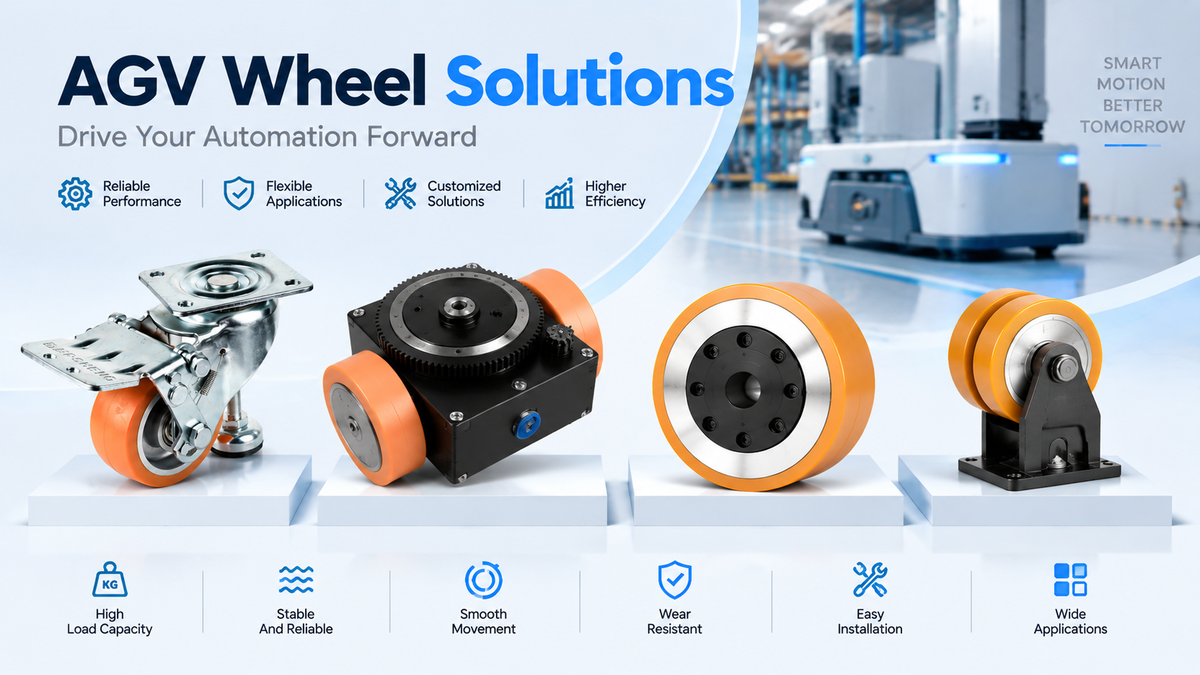
An AGV wheel system is more than a group of wheels mounted under a chassis.
Different wheels perform different jobs. Agv drive wheels generate motion. Agv caster wheels support the chassis and follow the movement of the drive system. Guide wheels are used in specific applications where additional mechanical guidance or lateral constraint is required.
Selecting each wheel separately without considering the complete chassis can lead to traction problems, excessive rolling resistance, unstable turning or uneven wheel wear.
For AGV and AMR designers, the more useful approach is to evaluate the wheel system as a whole. Vehicle weight, payload, drive configuration, floor condition, speed, installation space and maneuverability all need to work together.
This guide explains the differences between AGV drive wheels, caster wheels and guide wheels, and how to select and combine them for a reliable mobile robot platform.

AGV Drive Wheel Vs Caster Wheel Vs Guide Wheel At A Glance
Not every AGV uses all three wheel types.
Many compact AMRs, for example, use two powered drive wheels together with passive caster wheels. Steering-drive AGVs may combine one or more steering drive units with additional support wheels. Guide wheels normally appear only when the vehicle needs physical guidance against a rail, edge or other fixed structure.
| Factor | Drive Wheel | Caster Wheel | Guide Wheel |
| Main Function | Generate propulsion | Support chassis load | Provide mechanical guidance |
| Active/Passive | Active | Passive | Usually passive |
| Main Load | Vertical load + traction force | Mainly vertical load | Mainly lateral load |
| Direction Control | Depending on drive configuration | Follows chassis movement | Provides physical guidance only |
| Key Selection Factors | Torque, traction, load, wheel diameter, speed | Load, rolling resistance, swivel performance, floor condition | Lateral load, rigidity, alignment, wear |
| Typical Use | Differential drive, steering drive | AGV/AMR chassis support | Rail, edge or special guided systems |
The important difference is therefore not only how the wheels look, but what role they play in the complete AGV motion system.
AGV Drive Wheels: Converting Motor Torque Into Vehicle Motion
The drive wheel is the powered part of the wheel system. It transfers torque from the motor and gearbox to the floor and creates the force required to move the AGV.
Depending on the vehicle architecture, a drive wheel may provide propulsion only or combine propulsion and steering in one integrated unit.
Agv Differential Drive Wheels
A differential drive system normally uses two independently controlled drive wheels. When both wheels rotate at the same speed, the AGV travels straight. Changing the speed difference allows the vehicle to turn, while opposite wheel directions can enable rotation around the vehicle center.
This configuration is compact and works well for many AGVs and AMRs that require flexible turning without a separate mechanical steering mechanism.

Agv Steering Drive Wheels
A steering drive wheel combines driving and steering functions in one module. The assembly may include the drive motor, steering motor, gearbox, encoder, brake and wheel.
This gives the vehicle greater freedom in chassis layout and movement, especially for heavier AGVs, larger platforms or applications requiring more flexible positioning.
What Matters When Selecting An AGV Drive Wheel?
Drive wheel selection should not be based on load rating or motor power alone.
A suitable drive wheel needs enough usable traction and torque for the real operating conditions. Vehicle mass, payload, acceleration, slope, wheel diameter, gearbox ratio and floor surface can all change the requirement.
For example, a motor may provide enough rated power on paper, but the AGV can still struggle during startup if the gearbox ratio, wheel diameter or available traction is not suitable.
Floor condition is equally important. A smooth epoxy floor, dusty concrete floor and damp workshop floor can produce very different traction behavior.
This is why drive wheel selection is better treated as a vehicle-level calculation, not a catalogue choice.
Caster Wheels: Supporting The AGV Without Driving It
Caster wheels are passive support elements. They carry part of the vehicle weight and follow the direction created by the drive system.
They do not receive motor torque and normally do not actively control vehicle direction.
That sounds simple, but caster wheels can strongly influence AGV behavior.
A caster with excessive rolling resistance increases the force required to move the vehicle. Poor swivel behavior can create unstable direction changes. Incorrect load distribution can also reduce the normal force acting on the drive wheels and lower available traction.
For this reason, caster wheels should not be treated as secondary accessories.

Key Factors For AGV Caster Wheel Selection
The first consideration is load distribution.
The total vehicle weight should not simply be divided equally by the number of wheels. Battery position, payload location, chassis geometry and acceleration can cause individual casters to carry very different loads.
Wheel diameter also matters. Larger wheels generally pass floor joints and small obstacles more easily, while smaller wheels help maintain a low chassis height.
Tread material affects rolling resistance, noise, vibration, wear and floor protection. The best choice depends on the actual environment rather than one fixed hardness value.
Swivel geometry and bearing performance are especially important for AGVs that change direction frequently. A caster that does not align smoothly can increase resistance during turning and place additional load on the drive system.
Guide Wheels: Mechanical Guidance For Specific AGV Applications
Guide wheels are different from both drive wheels and caster wheels.
They are not a standard requirement for every AGV or AMR, and they should not be treated as the normal steering mechanism of the vehicle.
Guide wheels are typically used when a machine needs additional physical guidance or lateral constraint. This can occur in special transfer systems, rail-guided equipment, docking mechanisms or applications where the vehicle runs closely along a fixed structure.
Their design therefore focuses more on lateral load capacity, mounting rigidity, alignment and wear resistance than on traction or rolling efficiency.
A guide wheel that is poorly aligned can experience heavy side wear. A weak mounting structure can also allow the wheel position to shift over time, reducing guidance accuracy.
For most freely navigating AGVs and AMRs, direction is controlled by the powered drive system rather than by guide wheels.
How Drive Wheels And Caster Wheels Work Together
This is one of the most important points in an AGV chassis design.
A correctly selected drive wheel can still perform poorly if the support-wheel layout is wrong.
Load Distribution Affects Traction
Drive-wheel traction depends partly on the normal force between the wheel and the floor.
If too much vehicle weight is carried by the caster wheels, the powered wheels may become lightly loaded. This can reduce available traction and cause wheel slip during acceleration or turning.
The opposite is also undesirable. Excessive load on the drive wheels can increase mechanical stress and shorten component life.
The goal is a balanced chassis where each wheel carries an appropriate share of the load.
Caster Position Affects Turning Behavior
Caster placement relative to the drive-wheel axis influences vehicle stability and turning resistance.
Moving casters too far from the intended support position may increase the force required during rotation. Poor caster layout can also create chassis oscillation or uneven load transfer when the AGV changes direction.
Floor Contact Must Remain Stable
On an uneven floor, one wheel can temporarily carry less load than expected.
This matters particularly for differential drive systems because both powered wheels need reliable floor contact. If one drive wheel unloads, the vehicle can lose traction even when the motor and gearbox are correctly sized.
Common AGV Wheel Problems And What They Usually Indicate
| Problem | Possible Causes | What To Check |
| Drive Wheel Slipping | Insufficient traction, uneven load distribution, excessive acceleration | Floor condition, drive-wheel load, tread, torque requirement |
| Uneven Drive Wheel Wear | Chassis misalignment, incorrect installation, uneven loading | Wheel alignment, mounting, chassis geometry |
| High Rolling Resistance | Unsuitable caster, bearing resistance, excessive wheel deformation | Caster condition, tread, wheel diameter, bearing |
| Caster Vibration Or Shimmy | Swivel geometry, excessive speed, worn bearings | Caster offset, bearing condition, mounting |
| Excessive Floor Marking | Unsuitable tread or excessive wheel pressure | Wheel material, load distribution, floor surface |
| Side Wear On Guide Wheel | Misalignment or excessive lateral load | Guide-wheel position, mounting rigidity, contact angle |
These symptoms should be diagnosed as part of the whole chassis system.
Replacing one wheel without understanding the root cause can simply move the problem somewhere else.
How To Select The Right AGV Wheel System
A practical selection process starts with the vehicle, not the individual wheel.
First, define the basic operating requirements: vehicle weight, maximum payload, speed, acceleration, slope, duty cycle and floor condition.
Next, choose the drive architecture. A compact AMR may be well suited to differential drive, while a heavy or more flexible platform may benefit from steering drive units.
Once the drive architecture is defined, evaluate drive wheel diameter, torque, gear ratio, traction and load capacity together.
Caster wheels can then be selected and positioned based on remaining chassis load, stability, rolling resistance, swivel requirements and floor conditions.
Guide wheels should be added only when the application actually requires physical lateral guidance.
The final system should then be checked as one complete mechanical layout rather than as several independent components.
Drive Wheel, Caster Wheel And Guide Wheel Selection By Application
Different AGVs place different priorities on the wheel system.
| Application | Wheel-System Priorities |
| Compact Warehouse AMR | Low chassis height, flexible turning, low rolling resistance |
| Heavy-Duty AGV | Load capacity, torque, wheel strength, stable load distribution |
| Cleanroom AGV | Non-marking tread, low particles, smooth movement |
| Factory Transport AGV | Durability, frequent start-stop performance, floor compatibility |
| Agricultural Mobile Robot | Traction, contamination resistance, uneven-floor capability |
| Guided Transfer System | Lateral guidance, mounting rigidity, guide-wheel wear resistance |
This is why one standard wheel configuration cannot cover every AGV.
Wheel Tread Hardness Is Not A Standalone Selection Rule
Polyurethane hardness is often discussed when selecting AGV wheels, but hardness alone does not determine whether a wheel is suitable.
A harder tread can improve load capacity and reduce deformation, but may increase vibration or reduce floor protection. A softer tread can improve damping and noise performance, but may deform more under load or increase rolling resistance.
Drive wheels also require sufficient traction, while caster wheels generally need efficient rolling and smooth direction changes.
The final tread selection therefore needs to balance load, traction, wear, noise, floor protection and rolling resistance.
Fixed hardness values should be treated as product-specific references rather than universal AGV rules.
Why Wheel Diameter Matters
Wheel diameter affects more than the physical height of the AGV.
A larger wheel generally crosses joints, thresholds and small surface irregularities more easily. It can also change torque demand because the wheel radius determines how motor torque is converted into force at the floor.
Smaller wheels help create compact, low-profile platforms but may increase obstacle-crossing difficulty and require more torque for the same vehicle load and operating condition.
For drive wheels, diameter must therefore be considered together with the gearbox ratio and motor.
For caster wheels, diameter should also account for floor quality, load and available installation height.
Choosing The Wheel System For Different Drive Architectures
Differential Drive AGVs
A typical differential drive chassis uses two powered wheels together with passive support wheels.
This architecture is compact and can provide zero-radius turning, but the two drive wheels need stable ground contact and reasonably balanced loading.
Caster placement is therefore particularly important.
Steering Drive AGVs
A steering drive unit combines propulsion and steering.
Depending on chassis size and payload, the vehicle may use one, two or four steering drive units together with passive support wheels.
This architecture provides greater movement flexibility but requires more attention to installation space, steering synchronization and control.
Special Guided Systems
Some transfer platforms use additional guide wheels or rollers to follow a mechanical rail or edge.
These guide wheels should be treated as a separate mechanical guidance function rather than part of the normal navigation system.
How HKT ROBOT Supports AGV Wheel Selection
HKT ROBOT supports AGV and AMR projects with drive components including steering drive wheels, differential drive units, motors, gearboxes, servo drives and related motion components.
Instead of selecting a wheel from load rating alone, our engineering team can evaluate the vehicle weight, payload, speed, wheel diameter, gear ratio, floor condition, installation space and chassis layout together.
For new AGV projects, customers can provide the chassis drawing, vehicle weight, payload, speed, floor condition and available installation space. Based on these parameters, we can help evaluate a suitable drive and support-wheel configuration.
FAQs
1. What is the main difference between an AGV drive wheel and a caster wheel?
A drive wheel receives motor torque and generates vehicle motion. A caster wheel is passive and mainly supports the chassis while following the direction created by the drive system.
2. Does every AGV need guide wheels?
No. Guide wheels are normally used only when the vehicle requires physical lateral guidance, rail interaction, edge following or another form of mechanical constraint.
3. Can caster wheel selection affect drive wheel traction?
Yes. Caster quantity, location and load distribution can change how much normal force remains on the drive wheels. Poor load distribution may reduce available traction.
4. Why do AGV drive wheels slip?
Possible causes include insufficient traction, unsuitable floor conditions, uneven load distribution, excessive acceleration, incorrect wheel diameter or insufficient drive torque.
5. Should drive wheels and caster wheels use the same polyurethane hardness?
Not necessarily. The required tread properties depend on each wheel's function, vehicle load, floor condition, rolling resistance, traction and noise requirements.
6. Are larger AGV wheels always better?
No. Larger wheels improve obstacle-crossing performance but require more installation space and affect torque requirements. Wheel diameter should be matched to the chassis and operating environment.
7. Can worn caster wheels affect AGV positioning?
They can affect chassis stability and motion consistency. Excessive caster resistance, play or uneven wear may introduce disturbances that the drive and navigation systems need to compensate for.
8. What information should be provided for AGV wheel selection?
Useful information includes vehicle weight, payload, maximum speed, slope, floor type, chassis dimensions, drive configuration, available installation space and expected operating cycle.
Conclusion
AGV drive wheels, caster wheels and guide wheels may all appear under the same vehicle, but they perform very different functions.
Drive wheels create motion. Caster wheels support and follow. Guide wheels provide additional mechanical guidance only when the application requires it.
The most important selection principle is therefore not to optimize each wheel independently.
A reliable AGV starts with a balanced wheel system where drive architecture, load distribution, traction, wheel diameter, caster placement and floor conditions are considered together.
For projects where the correct configuration is not obvious, HKT ROBOT can review your vehicle parameters and chassis layout to help evaluate a suitable AGV drive and wheel solution.
Share:
Understanding 24V DC Servo Motors: Selection Guide, Applications And Key Differences From 48V Models
AGV Motor Selection Guide: How To Choose The Right Motor For Heavy Loads