

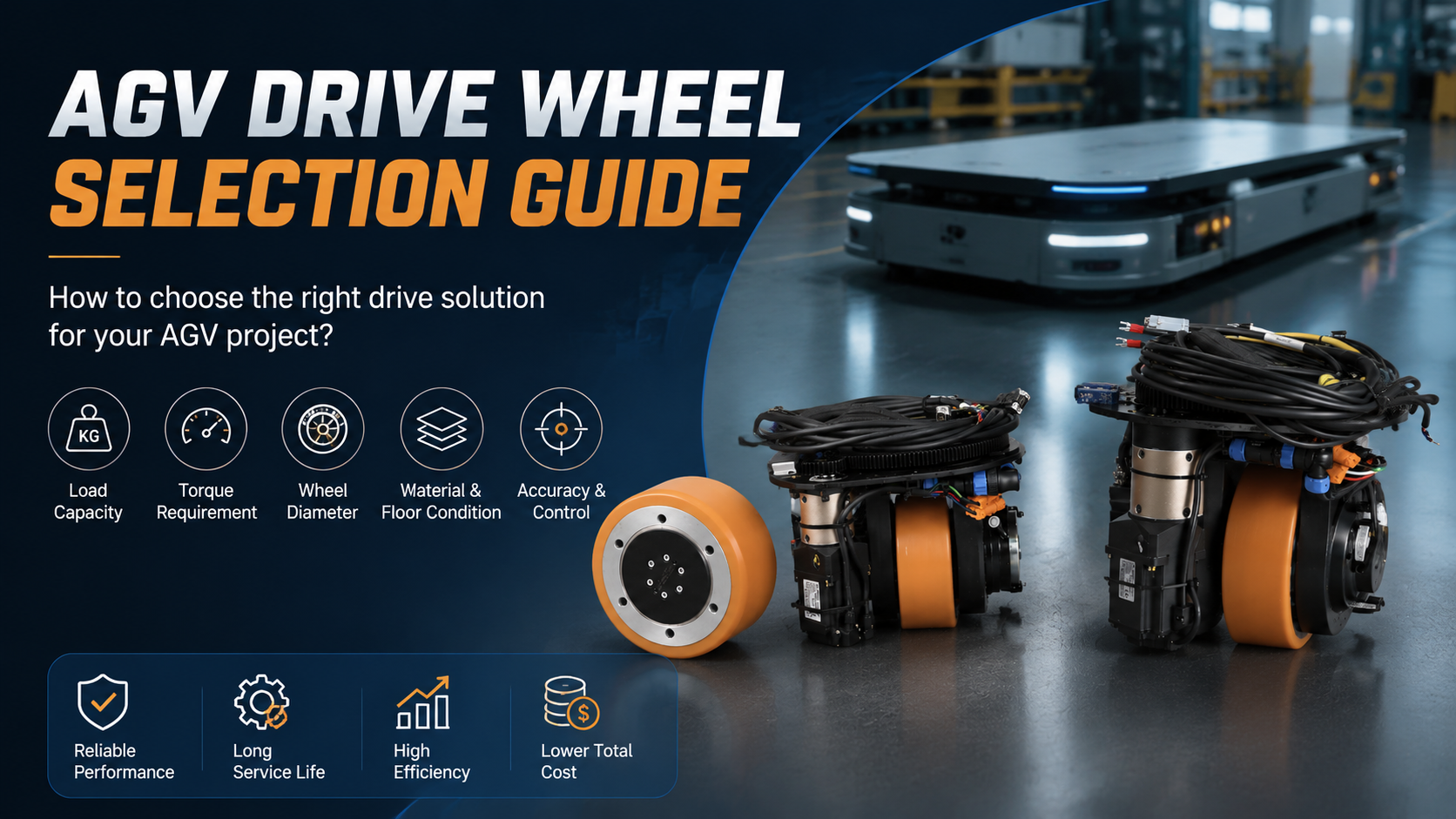
An AGV drive wheel may look like a simple moving component, but in reality, it plays an important role in transferring power for the entire mobile robot system.
It not only needs to support the vehicle load, but also transfer the torque from the motor to the ground effectively while maintaining stable operation over long periods.
Many AGV projects overlook one important point during the early design stage: the drive wheel is not an independent component.
It needs to be properly matched with motor, gearbox, encoder, control system, and vehicle structure.
AGV drive wheel selection is not about choosing the product with the highest specifications. It is about finding the right balance between performance, reliability and cost based on the actual application.

Key Parameters For AGV Drive Wheel Selection
The requirements for drive wheels are different in different AGV applications.
Light-duty warehouse AMRs may focus more on installation space, noise level and movement flexibility, while automotive manufacturing and heavy-duty handling AGVs usually pay more attention to load capacity, torque output and long-term operating stability.
The following parameters are usually important factors during AGV drive wheel selection:
| Parameter | Impact On Selection |
| Load Capacity | Determines wheel diameter, wheel hub strength and overall structural design |
| Torque Requirement | Determines AGV starting ability, acceleration and full-load operation capability |
| Wheel Diameter | Affects mobility, installation space and load distribution |
| Material And Hardness | Affects traction, noise and floor protection |
| Wear Resistance | Affects service life and maintenance cost |
| Floor Condition | Determines friction matching and driving stability |
| System Matching | Affects positioning accuracy and motion performance |
These factors are not independent.
For example, a higher hardness material may improve wear resistance, but it may not be suitable for every floor condition. A larger wheel diameter can improve mobility, but it may also affect installation space and gearbox matching.
Why AGV Drive Wheel Selection Often Causes Problems?
Focusing Only On Load Capacity And Ignoring Actual Operating Conditions
Many projects first check the maximum weight of the AGV when selecting drive wheels.
However, during actual operation, the load on the drive wheel is not only static weight.
Load changes during startup, acceleration, emergency braking and turning will all affect the actual forces.
For example, for a 2000kg AGV, the load carried by each drive wheel can be significantly different depending on the number of drive wheels, load center position and structural design.
If the selection is based only on average weight and does not consider the worst-case operating condition, the drive wheel may operate under excessive load for a long time, affecting service life.
Focusing Only On Motor Power And Ignoring Torque Matching
This is a common issue in AGV projects.
Many people believe that higher motor power means stronger AGV performance.
However, for mobile robots, especially heavy-duty AGVs, output torque is the key factor affecting starting ability and traction performance.
The final performance of an AGV drive system depends on:
-
Motor output
-
Gearbox ratio
-
Drive wheel size
-
Vehicle weight
-
Floor friction condition
If these parameters are not properly matched, even if the motor power meets the requirements, problems such as difficult full-load starting, insufficient climbing ability or unstable operation may still occur.
Focusing Only On Wear Resistance And Ignoring The Application Environment
Drive wheel service life is important.
However, wear resistance is not the only evaluation factor.
Different application environments have completely different requirements for drive wheels.
For example, in automotive manufacturing and heavy-duty logistics applications, drive wheels usually need to withstand long-term and high-load operation, so wear resistance and reliability are more important.
In cleanrooms or precision manufacturing environments, more attention needs to be paid to:
-
Low noise
-
Floor protection
-
Stable traction
A drive wheel that is suitable for rough industrial floors may not be suitable for every AMR application.
Key Parameters Analysis For AGV Drive Wheel Selection
The performance of an AGV drive wheel depends on the matching of multiple factors.
Therefore, during the actual selection process, multiple factors should be evaluated together instead of focusing on only one parameter.

Load Capacity: The Foundation Of Drive Wheel Structure
Load capacity is the basic condition for AGV drive wheel design.
In many projects, the drive wheel specification is selected directly according to the total AGV weight during the early stage. However, during actual operation, the load on the drive wheel is not simply evenly distributed.
Vehicle acceleration, emergency braking, turning and changes in the load center can all create additional forces.
For example, two AGVs with the same 2000kg load may have significantly different actual loads on each drive wheel due to different numbers of drive wheels and different structural layouts.
Therefore, engineering selection should focus on the maximum load condition instead of only the theoretical average weight.
Load capacity will ultimately affect:
-
Wheel diameter design
-
Wheel hub strength
-
Bearing specification
-
Overall structural design
For heavy-duty AGV applications, long-term fatigue risks during continuous operation should also be considered, rather than only meeting short-term load requirements.
Torque: Determines Whether The AGV Can Operate Stably
For an AGV system, speed is not the only performance indicator.
Especially in heavy-duty handling, towing AGVs and industrial production line applications, the vehicle needs sufficient output torque during startup to overcome large inertia resistance.
Many projects have a common misunderstanding: higher motor power means stronger AGV performance.
In reality, the final output capability depends on the overall matching of multiple factors, including motor torque, gearbox ratio, drive wheel size and vehicle weight.
If the torque is not properly matched, even if the motor power meets the requirements, problems such as difficult full-load starting, insufficient climbing ability or poor acceleration response may still occur.
Therefore, the drive wheel should not be evaluated separately. It needs to be matched with the motor and gearbox as a complete system.
Wheel Diameter, Material And Hardness: Affecting Traction Performance
The drive wheel is the key component that contacts the ground. Wheel diameter and material selection directly affect AGV operating performance.
A larger wheel diameter can usually improve obstacle crossing ability, reduce impact from uneven surfaces and improve adaptability to complex environments.
However, it also requires more installation space and may affect the matching of the motor and gearbox.
Material and hardness affect:
-
Traction performance
-
Rolling resistance
-
Noise level
-
Floor protection
For heavy industrial environments, wear resistance and stable traction are usually the main concerns.
For cleanrooms or precision manufacturing environments, low noise and floor protection may be more important.
Therefore, there is no absolutely optimal drive wheel material. The selection should be based on the actual operating conditions.
Wear Resistance: Affecting Long-Term Operating Cost
The purchase cost of a drive wheel is only one part of the AGV lifecycle cost.
For AGV systems running for long hours every day, drive wheel service life directly affects maintenance frequency and equipment availability.
If the wheel wears too quickly, it may not only increase replacement costs, but also lead to:
-
Equipment downtime
-
Increased maintenance frequency
-
Reduced production efficiency
Therefore, in high-frequency applications such as automotive manufacturing and warehouse logistics, wear resistance is usually an important evaluation factor.
However, wear resistance should also be evaluated based on the actual environment.
For low-frequency operation, pursuing extremely high wear resistance may not be necessary.
For continuously running industrial AGVs, extending service life can help reduce long-term operating costs.
Floor Condition: Determines Friction And Operating Stability
The drive wheel finally transfers traction force to the ground through friction, so floor condition is an important factor that cannot be ignored during selection.
Different floor environments affect:
-
Friction coefficient
-
Wear speed
-
Slip resistance
For example:
Epoxy floors usually require better floor protection.
Concrete floors usually require stronger wear resistance.
Cold storage environments need additional consideration of low-temperature conditions and slippery surfaces.
If the actual operating environment is ignored, even a drive wheel that meets the load and size requirements may still experience slipping, positioning deviation or abnormal wear.
Therefore, AGV drive wheel selection should be based on real application conditions instead of only referring to product specifications.
AGV Drive Wheel: Not An Independent Component, But Part Of A Complete Motion System
For modern AGV and AMR projects, the drive wheel is no longer just a mechanical component.
A stable mobile robot system requires proper matching between the drive wheel, motor, gearbox, encoder and controller.
For example, in a heavy-duty AGV project, the engineering team needs to determine:
Vehicle load → Single wheel load → Required torque → Gearbox ratio → Wheel diameter → Control feedback
Only when the entire system is properly matched can stable operation be achieved.
This is also why many AGV manufacturers prefer suppliers who can provide complete drive solution support instead of only purchasing individual components.

How To Choose An AGV Drive Wheel Supplier?
For standard applications, purchasing a suitable drive wheel product may already meet the requirements.
However, for customized AGV projects, the technical support provided by the supplier is equally important.
An experienced drive system supplier should be able to help customers:
-
Select suitable solutions based on load requirements;
-
Match the motor and gearbox;
-
Provide different drive structure options;
-
Support practical issues during development and operation.
Because the final goal of an AGV project is long-term stable operation, not simply achieving the highest value of a single parameter.
Why Choose HKT ROBOT As Your AGV Drive System Supplier?
Founded in 2013, HKT ROBOT focuses on AGV and AMR drive systems, providing complete motion solutions including AGV Drive Wheel, Steering Wheel, Differential Drive, Servo Motor, Gearbox and Controller.
Compared with suppliers that only provide standard components, HKT ROBOT focuses more on the matching of the complete drive system.
Based on customers’ application requirements, our engineering team can help evaluate drive structure, torque requirements, wheel selection, and motor and gearbox matching, helping reduce risks during AGV development.
Whether it is a warehouse AGV, heavy-duty handling AGV or customized industrial mobile robot project, HKT ROBOT can provide suitable drive solutions based on actual operating conditions.
If you are developing a new AGV project or looking to optimize an existing drive system, please provide the following information:
-
Maximum AGV load;
-
Travel speed;
-
Working environment;
-
Installation dimensions;
-
Drive configuration requirements.
HKT ROBOT will help evaluate a suitable AGV drive wheel and motion control solution based on your application requirements.
FAQs
1. How to calculate the required torque for an agv drive wheel?
The required torque needs to be calculated based on multiple factors, including AGV weight, wheel diameter, gearbox ratio, acceleration requirements and operating environment. It cannot be determined only by the vehicle weight.
2. Is a larger agv drive wheel always better?
No. A larger wheel diameter can improve mobility and obstacle crossing ability, but it may also affect installation space, cost and drive system matching.
3. Why does an agv experience wheel slipping during operation?
Possible reasons include:
-
Insufficient torque;
-
Low floor friction;
-
Incorrect wheel material selection;
-
Uneven load distribution.
The actual cause needs to be evaluated based on the complete operating conditions.
4. How should I choose between steering wheel and differential drive?
The choice depends on factors such as:
-
Load requirements;
-
Available installation space;
-
Steering method;
-
Positioning accuracy requirements.
Different AGV applications may require different drive structures.
Conclusion
AGV drive wheel selection is not simply about comparing load capacity or motor power.
A reliable solution requires comprehensive evaluation of load, torque, wheel diameter, material, floor condition and control requirements.
For AGV manufacturers, the right drive solution can improve equipment performance, reduce maintenance costs and increase overall system reliability.
The goal is not to choose the strongest individual component.
It is to choose the right solution for the actual application.
Share:
How to Select AGV Components for AGV and AMR Drive Systems
Understanding 24V DC Servo Motors: Selection Guide, Applications And Key Differences From 48V Models