

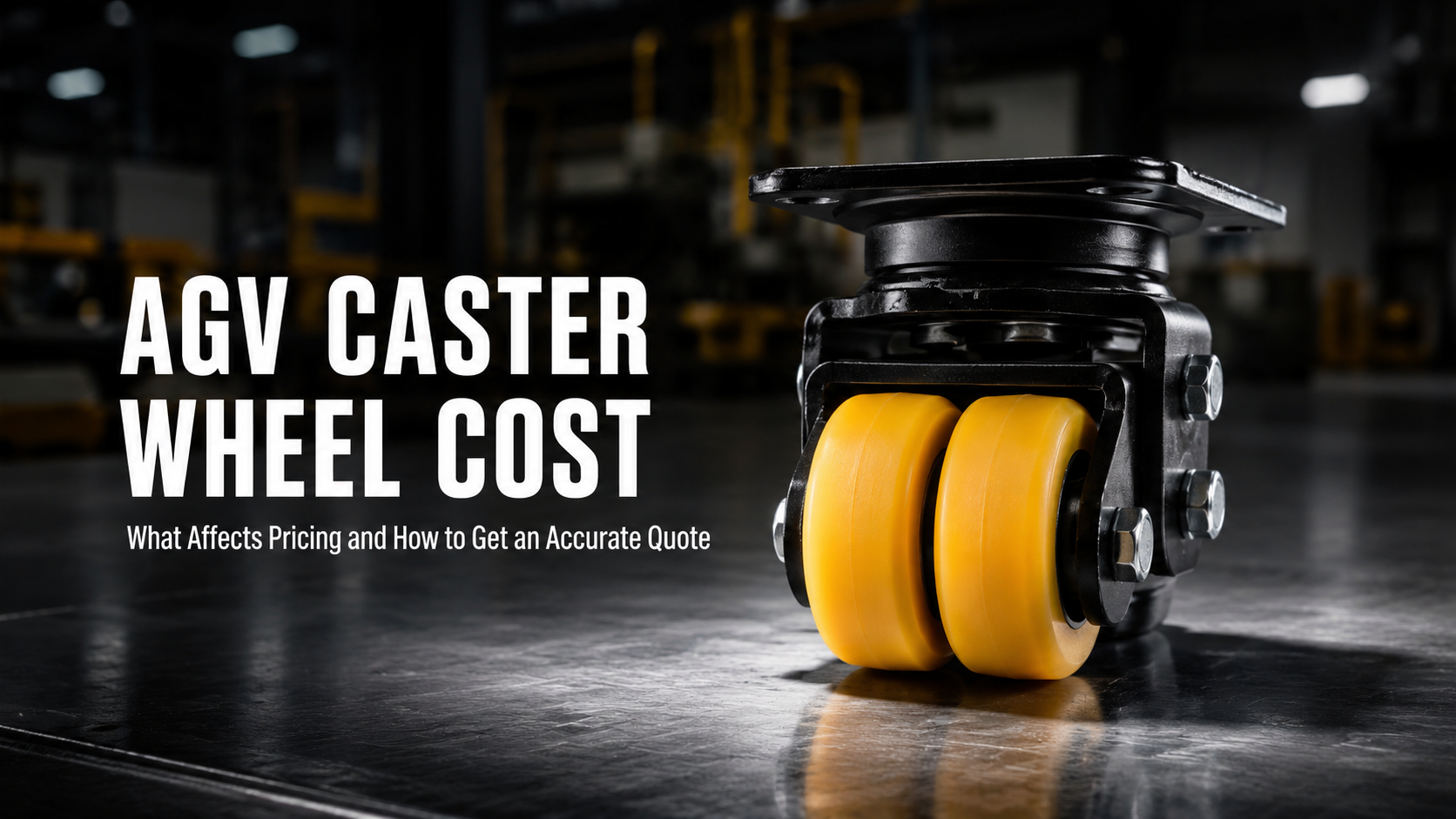
Two AGV caster wheels can look nearly identical on a spec sheet and still differ several times over in price. Caster wheels are often treated as a minor line item compared to drive motors or steering modules, but their cost varies widely based on material, load rating, mounting type, and order volume — and buyers who compare quotes on unit price alone often end up comparing wheels that are not actually equivalent. This guide breaks down what actually drives AGV caster wheel cost, what to check before requesting a quote, and the mistakes that most often lead to inaccurate pricing or a mismatched part.

Why AGV Caster Wheel Pricing Varies So Widely
Caster wheels serve a support role rather than a drive role, which can make them seem like a simple, standardized part. In practice, wheel tread material, core construction, bearing type, load capacity, swivel mechanism, and mounting hardware all vary independently, and each one affects cost. A caster rated for light-duty indoor use and a caster rated for heavy shock-absorbing duty can share the same wheel diameter and still carry a significantly different price, because the underlying construction is not the same.
Material and Construction: The Biggest Cost Driver
Wheel tread material has the single largest impact on caster wheel cost, since it determines load capacity, floor protection, rolling resistance, and expected service life.
Polyurethane vs Rubber vs Nylon Casters
Polyurethane treads generally cost more than rubber or nylon but offer better load capacity, floor protection, and resistance to cuts and abrasion, making them a common choice for AGV applications. Rubber casters tend to be less expensive and offer good shock absorption but generally carry lower load ratings. Nylon and other hard plastic wheels are typically the lowest cost option, suited to lighter loads and cleaner floor environments, but with limited shock absorption and higher noise levels.
Wheel Core and Bearing Type
The core material — steel, aluminum, or reinforced polymer — affects both cost and load capacity. Bearing type also matters: a caster with precision ball bearings or a roller bearing typically costs more than one with a simple bushing, but delivers smoother rolling resistance and a longer service life under continuous AGV operation.
Load Capacity and Duty Rating
Load rating is one of the clearest drivers of price, since higher-rated casters require heavier-duty materials and construction throughout the wheel and mounting assembly.
Light-Duty vs Heavy-Duty Casters
A light-duty caster designed for a few hundred kilograms per wheel costs meaningfully less than a heavy-duty caster rated for a ton or more, since the heavier-rated unit requires a larger wheel diameter, thicker tread, reinforced core, and a stronger mounting bracket to handle the load safely.
Dual-Wheel and Shock-Absorbing Designs
Dual-wheel casters and shock-absorbing designs, which distribute load across two wheels or incorporate a spring or elastomer damping mechanism, add cost over a standard single-wheel caster but reduce vibration transfer and improve stability for AGVs operating on uneven floors or carrying sensitive payloads.
Swivel Mechanism and Mounting Type
Beyond the wheel itself, the swivel mechanism and mounting hardware account for a meaningful share of total caster cost.
Swivel vs Rigid Casters
Swivel casters, which allow the wheel to rotate around a vertical axis, cost more than fixed rigid casters due to the additional bearing and mounting components required. Some AGV designs use a mix of both, with rigid casters providing directional stability and swivel casters providing maneuverability.
Mounting Plate vs Stem Mount
Mounting hardware type — a plate mount versus a stem or kingpin mount — affects both cost and installation compatibility with a given chassis design. Buyers should confirm mounting dimensions match their chassis before comparing prices, since a lower-cost caster with an incompatible mount can end up costing more once adapter hardware is factored in.
Order Volume and Customization
Beyond the physical specifications of the wheel, how the order itself is structured has a significant effect on unit price.
Standard Catalog Casters vs Custom Specifications
A caster selected from an existing product line, with standard wheel diameter, load rating, and mounting configuration, is typically less expensive than a fully custom design requiring new tooling or a non-standard combination of specifications.
How Order Quantity Affects Unit Price
As with most industrial components, unit price generally decreases as order volume increases, since fixed costs such as tooling and setup are spread across a larger batch. Buyers evaluating cost for a small pilot order should expect a different per-unit price than the same specification at full production volume, and should ask suppliers to quote both figures for accurate budget planning.

What to Include in a Caster Wheel Quote Request
An accurate quote depends on the completeness of the request. At minimum, a quote request should specify wheel diameter and width, required load capacity per wheel, tread material preference if known, swivel or rigid configuration, mounting type and dimensions, floor environment, and expected order volume. Providing this information up front reduces the number of quote revisions needed and helps ensure the quotes being compared are actually for equivalent parts.
Common Mistakes That Lead to Inaccurate Quotes
Most pricing confusion in caster wheel sourcing comes down to a small number of recurring issues. Comparing quotes based on wheel diameter alone, without confirming load rating or tread material, often leads to comparing parts that are not actually equivalent. Omitting mounting dimensions can result in a quoted caster that does not physically fit the chassis. And requesting pricing for a single small quantity when the actual project volume will be much larger can produce a per-unit price that does not reflect the real cost at scale. For a deeper look at how these specifications interact, see this AGV caster selection guide covering material to parameters.
FAQ
Why do two similar-looking caster wheels have different prices?
Wheel diameter is only one variable. Tread material, core construction, bearing type, load rating, and swivel mechanism can all differ between two casters of the same size, and each of these affects cost independently.
Does a higher price always mean a better caster wheel?
Not necessarily. A higher price often reflects higher load capacity, better materials, or a more complex swivel mechanism, but the right caster is the one that matches your actual load, floor, and duty cycle requirements rather than the highest-rated option available.
How much does order volume typically affect caster wheel pricing?
The exact discount varies by supplier and specification, but unit price generally decreases as volume increases, since tooling and setup costs are spread across more units. Requesting pricing at multiple volume tiers gives a clearer picture for budget planning. For background on how casters fit into the broader chassis design, see this overview of AGV caster wheels as part of the chassis mechanical system.
What information should I provide to get an accurate caster wheel quote?
Wheel diameter and width, required load capacity, tread material preference, swivel or rigid configuration, mounting type and dimensions, floor environment, and expected order volume are the minimum details needed for a supplier to quote accurately.
Are custom caster wheels significantly more expensive than standard ones?
Custom specifications typically cost more than standard catalog options, primarily due to tooling and engineering time, but the difference depends on how far the requirement deviates from existing product configurations. Configuration-level changes within an existing product line usually cost less than a fully custom design.
Conclusion
AGV caster wheel cost is shaped by far more than wheel diameter — material, load rating, bearing type, swivel mechanism, mounting hardware, and order volume all play a role, and skipping any of them when requesting a quote makes it difficult to compare pricing accurately across suppliers. Buyers who provide complete specifications up front, and who confirm that the parts being quoted are actually equivalent, are in a much stronger position to evaluate cost fairly and avoid mismatched parts or unexpected repricing later in the project.
Share:
Planetary Gearboxes for AGV/AMR and Automation Systems
48V DC Servo Motor for AGV and AMR